
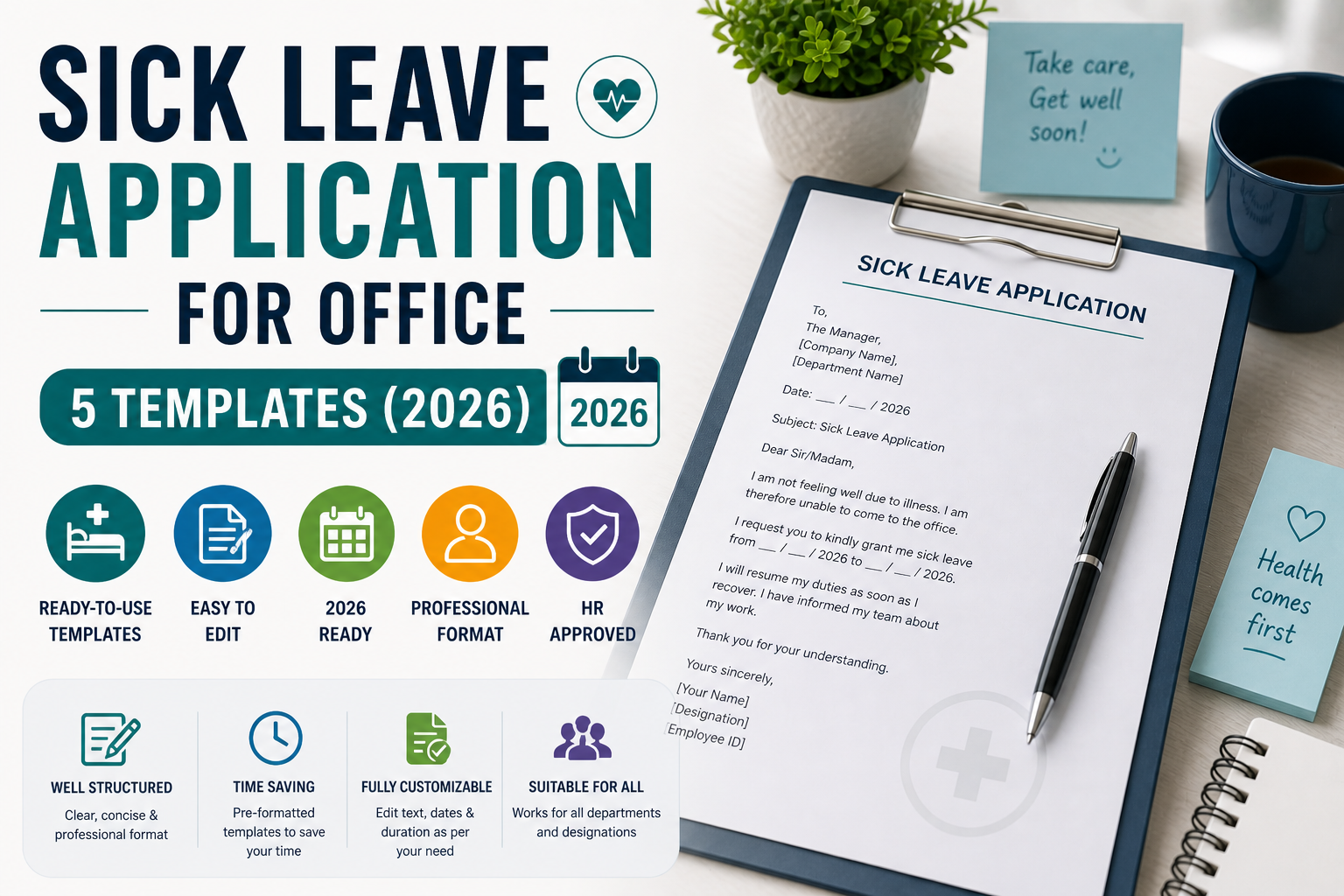
Getting ill is never planned — and having to communicate your absence professionally to your workplace while you are already feeling unwell adds an unnecessary layer of stress to an already difficult day. The good news is that a sick leave application does not need to be long, complicated, or formal in an intimidating way. What it does need to be is clear, prompt, and professional.
Whether you are dealing with a sudden fever, a chronic health issue requiring a few days’ rest, a medical procedure, or caring for a sick child or family member, knowing how to write a proper sick leave application for the office ensures your absence is handled respectfully — by you and by your employer.
In this complete guide, you will find five ready-to-use sick leave application templates for different situations, a straightforward writing guide, the key information every application must include, and clear answers to the most commonly asked questions about sick leave at work.
1. What Every Sick Leave Application Needs
Regardless of the seriousness of your illness or the length of your absence, every effective sick leave application for the office contains the same core elements. Missing even one of these can create back-and-forth with HR or your manager that delays approval and prolongs an already stressful situation.
- Your name, designation, and department: Identifies you clearly — especially important in larger organisations with several employees named similarly.
- The specific date(s) you are requesting off: Avoid vague language like “a few days.” State exact dates every time.
- A brief, professional description of your condition: You do not need to share medical details. “Illness,” “fever and flu symptoms,” “a medical procedure,” or “a health condition requiring rest” is sufficient.
- Your expected return date (if known): If uncertain, say so — “I will update you once I have more clarity from my doctor” is a perfectly appropriate statement.
- Who is handling urgent work in your absence: Even one sentence about this removes significant stress from your manager.
- Willingness to submit medical documentation: State that you can provide a doctor’s note upon your return, if your company policy requires it.
- A polite closing and your signature: Keep the closing brief and professional.
2. How to Write a Sick Leave Application — Step by Step
Contact Your Manager As Early as Possible
Before you send the written application, send a quick notification — a text, call, or instant message — to let your manager know you won’t be in. This buys the team time to prepare while your formal email follows. Most businesses expect to be informed before or at the start of your scheduled shift.
Be Honest — But Keep Medical Details Private
You do not need to describe symptoms in detail or overshare private medical information. Your employer has no legal right to require detailed health information in most countries. A brief, honest statement like “I am unwell with flu-like symptoms and have been advised by my doctor to rest” is both truthful and professionally appropriate.
Give Your Best Estimate of Return — Update If Needed
If you are confident you will be back on a specific date, state it clearly. If you are unsure (e.g., you are awaiting surgery or a medical diagnosis), say “I expect to return on
Briefly Note Who Is Covering Urgent Work
Even when you are ill, taking a moment to mention “I have briefed
Keep the Tone Warm but Professional
You are not writing a formal legal document — but you are not writing a casual text to a friend either. Aim for the tone of a professional who is simply communicating a practical reality: you are unwell, you need rest, and you will be back as soon as you are able. Brief, clear, and human.
3. Five Sick Leave Application Templates
Template 1 — General Sick Leave Email (Same Day)
To: [Manager’s Email]
Subject: Sick Leave — [Your Name] — [Today’s Date]
Dear [Manager’s Name],
I am writing to inform you that I am unwell today and am unable to come into the office. I am experiencing [brief, general description: e.g., a high fever / flu symptoms / a severe migraine] and have been advised by my doctor to rest.
I am requesting sick leave for today, [date]. I expect to return to the office on [return date], but I will update you if my condition changes.
I have informed [colleague’s name] of any urgent actions required today, and they have agreed to assist where needed. I will remain reachable by email for anything critical.
Please find or request my medical documentation upon my return, as per company policy. I apologize for any inconvenience this causes.
Thank you for your understanding.
Regards,
[Your Full Name]
[Designation / Department]
Template 2 — Multi-Day Sick Leave Application (Formal Letter)
To: [Manager’s Name / HR Manager]
From: [Your Full Name], [Designation, Department]
Date: [Today’s Date]
Subject: Sick Leave Application — [Start Date] to [End Date]
Respected [Sir / Ma’am],
I am writing to formally request sick leave from [start date] to [end date] (total: [number] days), as I am currently unwell with [brief description: e.g., a viral infection / a medical condition requiring rest and treatment].
I visited my doctor on [date], and I have been advised to rest for the above period. I am attaching / will provide upon my return the medical certificate issued by my doctor as required by company policy.
I have ensured that all urgent tasks have been communicated to [colleague’s name], who has agreed to handle them in my absence. I will make every effort to check email periodically for anything that requires my immediate attention.
I sincerely apologize for any inconvenience caused by my absence and request your kind approval for this sick leave.
Respectfully,
[Your Full Name]
Template 3 — Sick Child / Dependent Care Leave
To: [Manager’s Name]
Subject: Sick Leave — Child Care — [Date]
Dear [Manager’s Name],
I am writing to inform you that my [child / dependent / family member] is unwell and requires my care today. As I am unable to arrange alternative care at short notice, I am requesting sick / dependent-care leave for [today / [date range]].
I will catch up on all outstanding work on my return and have flagged the most urgent matters with [colleague’s name] to avoid any delays. I will be available via email and phone for any urgent matters.
Thank you for your understanding. I expect to return to the office on [expected return date].
Kind regards,
[Your Full Name]
Template 4 — Sick Leave for Medical Procedure or Surgery
To: [Manager’s Name / HR Manager]
From: [Your Full Name], [Designation]
Date: [Date]
Subject: Medical Leave Application — [Date Range]
Dear [Manager’s Name],
I am writing to formally request medical leave from [start date] to [end date]. I am scheduled to undergo [procedure / surgery / medical treatment — keep it general: e.g., a planned medical procedure / a surgical procedure recommended by my physician] on [date] and will require the indicated recovery period.
I have been working to complete all current projects ahead of my leave date and will ensure a comprehensive handover to [colleague’s name] before I go. I will submit my doctor’s recommendation and discharge documents as required by HR policy upon my return.
I have planned this leave as carefully as possible to minimize the impact on the team and I sincerely appreciate your understanding and support.
Respectfully yours,
[Your Full Name]
Template 5 — Short Sick Leave (WhatsApp or Text Message Format)
Hi [Manager’s Name], I’m not feeling well today and won’t be able to come in. I’m requesting a sick leave for [today / date]. I’ve let [colleague’s name] know about any urgent tasks. I’ll keep you updated and expect to be back by [return date]. I’ll send a formal application email as well. Thank you for understanding.
4. Common Mistakes to Avoid in Sick Leave Applications
Not informing your manager until after your shift starts — Always notify before your working hours begin, even if it is just a quick call or message first.
Over-sharing medical details — You are not required to describe symptoms in graphic detail. Brief and professional is always appropriate.
Leaving work completely unaddressed — Even one sentence about who is handling urgent tasks shows professionalism and prevents team disruption.
Giving a vague return date — “I’ll be back when I feel better” creates planning problems. Always give your best estimate, even if that estimate might change.
Applying for sick leave retroactively without explanation — If you were too unwell to write even a message, acknowledge that upon your return and explain briefly. Most managers are reasonable when given honesty.
Missing the medical certificate requirement — Know your company’s policy. Many require a doctor’s note for absences of three or more days. Failing to provide one can result in the leave being marked as unauthorized.
5. When and How to Submit a Doctor’s Note
A doctor’s note (also called a medical certificate) is an official document from a licensed healthcare provider confirming that you were ill and unfit to work on specific dates. Here is what you should know about them:
- When is it required? Most organisations require a medical certificate for sick absences of 3 or more consecutive days. Some require one from day one for employees with a pattern of frequent sick leave.
- What should it contain? Your name, the date of consultation, the dates you were advised to rest, and the doctor’s signature and registration number. It should not typically include your diagnosis without your consent.
- When should you submit it? On or shortly after your first day back at work. If you anticipate needing it, mention in your application that you will bring documentation upon return.
- What if you were treated at home without seeing a doctor? If your illness was minor and lasted only one or two days, most organisations do not require documentation. If it lasted longer, try to at least consult a telehealth doctor who can issue a certificate remotely.
- Can your employer request it? Yes — most employment contracts allow employers to request medical documentation. Refusing to provide it for an extended absence can affect whether the leave is paid or approved.
6. Frequently Asked Questions
Rest First. Write It Right. Return Strong.
A sick leave application does not need to be complicated — it just needs to be timely, clear, and professional. Use any of the five templates in this guide to handle your workplace communication quickly, so you can focus on what actually matters: getting better and returning to work at full capacity.