
Deciding to leave a job is one of the most significant professional moves you can make — and the resignation letter you write in the days that follow that decision will have a lasting impact on how your departure is remembered. A well-written resignation letter doesn’t just fulfill a formal requirement; it protects your professional relationships, preserves your reputation, and ensures you receive a positive reference when you need it most.
The challenge is that most people have never been taught how to write one properly. They either write something so brief it seems dismissive, or so emotional it becomes awkward to read. Neither serves you well. What you need is a professional, clear, gracious letter that says everything necessary — and nothing that doesn’t need to be said.
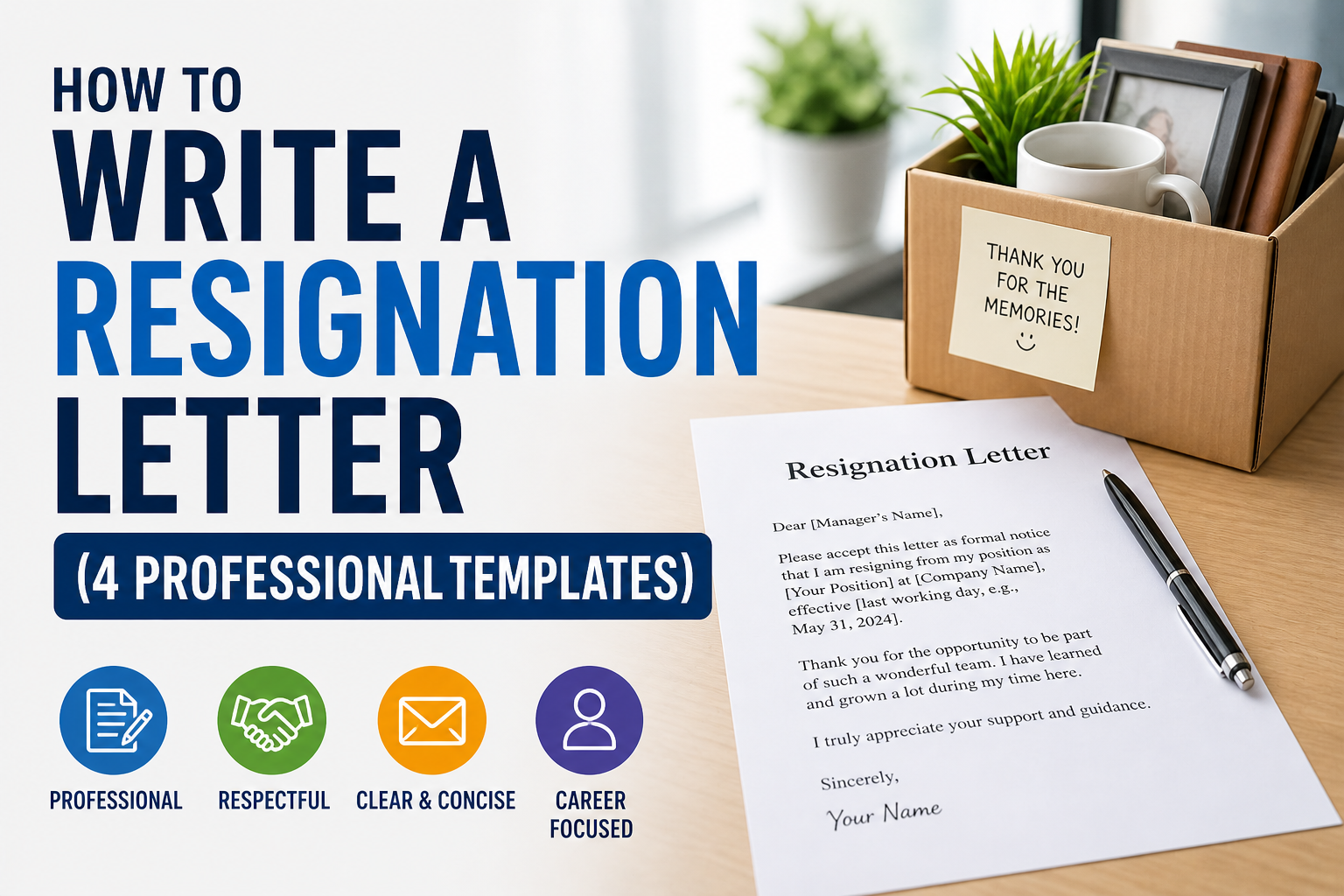
This complete guide covers exactly what to write in a resignation letter, what to leave out, the seven core elements every resignation letter needs, four copy-ready professional templates for different situations, and the critical mistakes you must avoid when leaving any job.
1. Why Your Resignation Letter Matters More Than You Think
Many people treat their resignation letter as a formality — a piece of paper to get through before moving on to what really matters. In reality, it is one of the most professionally consequential documents you will ever write in your career, for three very specific reasons.
First, it becomes part of your permanent employment record. HR departments keep resignation letters on file. If a future employer calls for a reference check, the tone and content of your departure can influence how your former employer speaks about you — positively or otherwise.
Second, industries are smaller than they appear. Managers move between companies. Colleagues become hiring managers. The person you brush off today could be sitting across the table from you in a job interview three years from now. Burning a bridge professionally is almost never worth whatever short-term satisfaction it provides.
Third, it sets the tone for your final weeks. A graciously written resignation letter tends to generate a gracious, cooperative response. The manner in which you leave can determine whether your remaining time is professional and productive — or uncomfortable and difficult for everyone involved.
2. The 7 Elements Every Resignation Letter Needs
- Formal greeting: Address your direct manager by name — not “To Whom It May Concern.”
- Clear statement of resignation: State plainly that you are resigning from your position. No ambiguity.
- Your last working day: Specify the exact date, calculated from your notice period (typically two weeks).
- A brief, genuine expression of gratitude: Acknowledge what the role, company, or team gave you — professional growth, skills, experience, or relationships.
- An offer to assist with the transition: Offer to help train a replacement, complete outstanding projects, or prepare handover documentation. This is both professional and practical.
- Positive closing statement: End with a warm, forward-looking sentence that wishes the company or team continued success.
- Professional sign-off: “Sincerely,” “Respectfully,” or “With appreciation,” followed by your full name.
Notice what is not on this list: your reasons for leaving, your complaints about management, your feelings about the company culture, or any comparison to your new role. All of these things might feel important to say — but including any of them in the letter serves you poorly and professionally.
3. Step-by-Step Guide to Writing Your Resignation Letter
Choose Email or Printed Letter Based on Your Workplace Culture
Most modern workplaces expect an email resignation, with a follow-up in-person conversation with your manager. More traditional or formal organisations may expect a printed, signed letter delivered directly. When in doubt, do both — print and sign the letter, then send it via email simultaneously to ensure it reaches HR and your manager at the same time.
Tell Your Manager Before You Send the Letter
Whenever possible, have a private conversation with your direct manager before your resignation letter arrives in writing. This shows respect and gives them time to prepare, rather than being blindsided by a formal email. The letter should confirm what was already discussed verbally — not be the first time they hear it.
Calculate Your Last Working Day Accurately
Check your employment contract for your required notice period before you write anything. State your last working day as a specific calendar date. “I am providing two weeks’ notice” is less clear than “My last working day will be Friday, the 16th of May, 2026.” Precision prevents misunderstandings.
Keep the Tone Warm but Professional Throughout
Write in a tone that is genuine but measured. Think of it as a professional thank-you letter, not an emotional goodbye. If you had a difficult time at the company, this is not the place to address it. Save whatever honest reflections you have for the exit interview, where that kind of feedback is both appropriate and expected.
Proofread, Sign, and Send Promptly
Check for typos, grammar errors, and the correct spelling of your manager’s name. Resign as early in the workweek as possible — a Monday or Tuesday resignation gives your employer more time to plan and typically leads to a smoother final period than a Friday afternoon letter.
4. Four Professional Resignation Letter Templates
Template 1 — Standard Professional Resignation
Dear [Manager’s Name],
I am writing to formally notify you of my resignation from my position as [your job title] at [Company Name]. In accordance with my notice period, my last working day will be [specific date].
This has been a genuinely difficult decision. I am grateful for the opportunity to have worked with such a talented team, and I value the experience and professional growth I have gained during my [number] years here.
I am fully committed to making this transition as smooth as possible. I am happy to assist with training my replacement, completing any outstanding work, and preparing detailed handover documentation before my departure.
I wish you and the entire team continued success, and I hope to stay in touch professionally.
Sincerely,
[Your Full Name]
Template 2 — Resignation When Leaving for Career Growth
Dear [Manager’s Name],
Please accept this letter as my formal resignation from my role as [your job title] at [Company Name], effective [last working day].
I have accepted an opportunity that aligns with my long-term career goals, and after considerable reflection, I have decided to pursue it. I want to be clear that this decision is not a reflection of my experience here — I have found this role genuinely rewarding and the team truly exceptional.
I am thankful for the mentorship, responsibilities, and professional development I have experienced at [Company Name]. The skills and relationships I’ve built here will undoubtedly contribute to my future success.
I will do everything I can to ensure a smooth transition during my remaining time, and I am available to assist with handover in whatever way is most helpful to the team.
With sincere appreciation,
[Your Full Name]
Template 3 — Immediate or Short-Notice Resignation (Personal Reasons)
Dear [Manager’s Name],
I am writing to inform you of my resignation from my position as [your job title] at [Company Name], effective [date — noting reduced notice if applicable].
I deeply regret that I am unable to provide my full standard notice period. Due to [personal/family/health circumstances — keep this brief and professional], I find myself needing to step away from my role sooner than I would have wished.
I sincerely apologize for any inconvenience this shortened notice period may cause the team. I am committed to doing everything possible before my departure to minimize disruption — including completing any urgent tasks, preparing documentation, and briefing colleagues on outstanding work.
I am grateful for the time I have spent at [Company Name] and for the opportunities you have given me. I hope you will understand the personal nature of this decision.
Respectfully,
[Your Full Name]
Template 4 — Long-Tenured Employee Resignation
Dear [Manager’s Name],
After [number] rewarding years with [Company Name], it is with a mix of gratitude and sadness that I submit my formal resignation from my role as [your job title]. My last working day will be [specific date].
The decision to leave has not come easily. This organisation has been central to my professional life for a significant chapter of my career, and I carry with me an enormous amount of pride in what we have accomplished together. The teams I have led, the projects I have delivered, and the colleagues who have become genuine friends — all of this has shaped who I am as a professional.
I am committed to doing everything within my power to ensure a thorough and well-organized transition. I will work closely with [HR / my successor / the team] over the coming weeks to ensure continuity and to leave things in the best possible order.
Thank you sincerely for the trust, the challenges, and the extraordinary opportunities this company has provided me over the years.
With deep gratitude,
[Your Full Name]
5. Do’s and Don’ts of Resigning Professionally
| ✅ Do This | ❌ Avoid This |
|---|---|
| Tell your direct manager first, before anyone else | Telling colleagues before your manager finds out |
| Give the proper notice period per your contract | Leaving without notice or disappearing |
| Keep the letter positive and professional throughout | Using the letter to vent about management or culture |
| Offer to help with the transition | Disengaging from work the moment you resign |
| Stay engaged and productive until your last day | Becoming visibly checked-out or negative |
| Send a goodbye email to colleagues on your last day | Burning bridges or leaving loose ends behind |
6. Frequently Asked Questions About Resignation Letters
Leave Well — and Leave the Door Open Behind You.
Your resignation letter is your final professional statement at every company you leave. Written well, it protects your reputation, preserves your relationships, and ensures that whatever comes next, you are remembered as someone who handled their exit with grace and integrity. Use any of the four templates above — personalize them, send them promptly, and walk into your next chapter with confidence.