
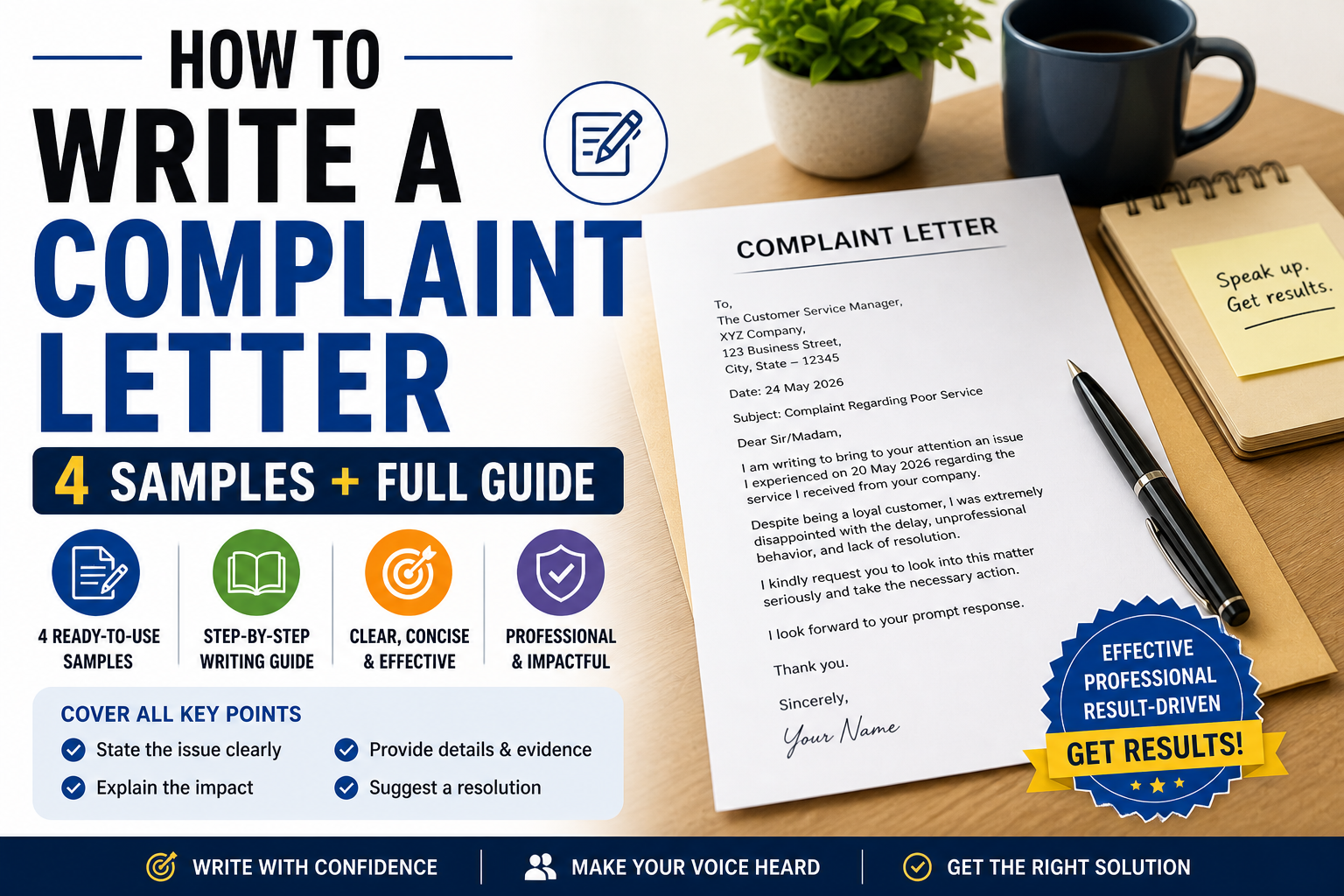
There is a meaningful difference between venting about a bad experience and writing a complaint letter that actually achieves something. Most people instinctively do the former — they write from a place of frustration, the letter becomes emotional and accusatory, and the result is either ignored entirely or triggers a defensive response that leaves both sides further apart than when they started.
Effective complaint letters work differently. They are calm, factual, and professionally assertive. They present the problem with precision, acknowledge what the reader needs in order to act, and state clearly what outcome the writer is seeking. Done right, a well-written complaint letter is one of the most powerful tools you have as a consumer, employee, or business professional — and it routinely achieves results that emotional outbursts and verbal arguments never do.
In this complete guide, you will find a 7-step process for writing a complaint letter that gets results, four sample complaint letters across different common situations, a comparison of what works versus what backfires, and the most-asked questions about complaint letter writing.
1. Why a Written Complaint Letter Is More Powerful Than a Call
Most people’s first instinct when something goes wrong is to pick up the phone. And while phone calls can be fast, they are often ineffective for serious matters — because they leave no record, rely on whoever happens to answer, and allow the other party to brush you off without accountability.
A written complaint letter changes the dynamic significantly:
- It creates a documented record: A written letter establishes a timeline and a paper trail that becomes enormously valuable if the dispute escalates — to a regulator, an ombudsman, or legal proceedings.
- It forces the reader to take you seriously: Someone who has taken the time to write a formal, well-structured letter is immediately perceived as more serious and less likely to give up than a caller.
- It goes to the right person: A complaint letter addressed to a senior manager, a Customer Experience Director, or a CEO reaches decision-makers — not frontline staff with limited authority.
- It removes emotional volatility: It gives you time to state your case calmly and completely, without the pressure of a real-time conversation that can escalate or derail.
- It sets a formal timeline: By stating “I expect a response within 14 days,” you create a real accountability mechanism that a phone complaint almost never achieves.
- It is admissible as evidence: If the complaint ever reaches a formal dispute process, your documented letter can be referenced to show the timeline and reasonableness of your position.
2. Types of Complaint Letters
Complaint letters are used across a wide range of personal, professional, and consumer situations. The core structure remains consistent, but the tone and specific content shift depending on the context. The most common types include:
| Type | Common Use Cases |
|---|---|
| Consumer Complaint | Defective product, poor service, billing error, delivery failure, subscription issues |
| Workplace Complaint | Harassment, discrimination, bullying, unsafe conditions, unpaid wages, policy violations |
| Landlord / Housing Complaint | Maintenance failures, uninhabitable conditions, unlawful entry, deposit disputes |
| School / Institution Complaint | Bullying, inadequate teaching standards, unfair grading, administration failures |
| Neighbour Complaint | Noise, property damage, boundary disputes, anti-social behaviour |
| Government / Council Complaint | Infrastructure failures, planning decision disputes, service delivery failures |
| Healthcare Complaint | Misdiagnosis, negligent care, billing errors, lack of informed consent |
3. Seven Steps to Writing an Effective Complaint Letter
Address It to the Right Person
Do not address your letter vaguely to “Customer Service” or “To Whom It May Concern.” Research and name a specific senior person — a Customer Experience Manager, a Department Head, a Company Director. A named complaint letter is significantly more likely to be actioned than a generic one. Look on the company’s website, LinkedIn, or call reception to get the correct name and title.
Write a Precise, Clear Subject Line
Your subject line should include the nature of the complaint and any relevant reference number. For example: “Formal Complaint — Failed Service Delivery — Order #45892 — [Your Name].” This tells the reader exactly what they are dealing with before they read a single line of the letter itself and makes filing and responding significantly easier for the recipient.
State the Facts — Precisely and Chronologically
Open by stating exactly what happened, in chronological order, with dates, times, reference numbers, names of staff you spoke with, and any other relevant details. Facts are the backbone of every effective complaint. The more specific your timeline, the more credibility your complaint carries — and the less room the recipient has to deny or reframe the situation.
State Clearly How It Has Affected You
After presenting the facts, explain briefly and specifically how this situation has affected you — financially, practically, or in terms of your time. This is different from emotional venting; it is a direct statement of impact. For example: “As a direct result of this error, I incurred additional costs of $85 and was unable to fulfil a work commitment.” Concrete impact statements carry weight that generalizations do not.
State Your Desired Resolution — Specifically
This is the step most people skip — and it is the most important one. Tell the recipient exactly what you want: a refund, a replacement, a written apology, a specific action to be taken, compensation for documented costs. A complaint that does not state a desired outcome gives the recipient too much room to respond insufficiently. Be specific, be reasonable, and be clear.
Set a Response Deadline
Give a reasonable but firm deadline for a response: “I expect a formal response to this complaint within 14 business days of receiving this letter.” This creates urgency and accountability. It also gives you a clear trigger point for escalation if the deadline passes without a satisfactory response.
State What Happens If Your Complaint Is Not Resolved
Without making threats, calmly state your escalation path: “Should I not receive a satisfactory response within the above timeframe, I will have no alternative but to escalate this matter to [relevant regulator / ombudsman / consumer protection agency / legal counsel].” This demonstrates that you know your rights and are prepared to act — which is often what prompts a company to resolve things promptly.
4. Four Sample Complaint Letters
Sample 1 — Consumer Complaint (Defective Product or Poor Service)
[Your Full Name]
[Your Address]
[City, Country, Postcode]
[Date]
[Name & Title of Recipient]
[Company Name]
[Company Address]
Subject: Formal Complaint — [Product/Service Name] — Reference: [Order / Account Number]
Dear [Recipient’s Name],
I am writing to formally register a complaint regarding [product / service] purchased from your company on [date of purchase] (Order Number: [number]).
On [date], I contacted your customer service team to report [describe the specific issue: e.g., the product arrived damaged / the service was not performed as described / the product failed within the warranty period]. Despite being assured that this would be resolved by [date], the issue remains unresolved as of the date of this letter. I have attached copies of my original purchase receipt, the email correspondence with your team, and photographic evidence of the issue.
As a result of this failure, I have [describe the impact: e.g., been unable to use the product / incurred additional costs / experienced significant inconvenience].
I am requesting the following resolution: [e.g., a full refund of £XXX / a replacement product / a service re-delivery at no additional cost]. I expect a formal written response to this complaint within 14 business days of the date above.
If this matter is not resolved satisfactorily within the above timeframe, I will have no alternative but to escalate this matter to [relevant regulatory body / consumer affairs agency / trading standards].
Yours sincerely,
[Your Full Name]
Sample 2 — Workplace Harassment or Bullying Complaint
To: [HR Manager / Director / Named Senior Manager]
From: [Your Full Name], [Designation, Department]
Date: [Date]
Subject: Formal Workplace Complaint — [Nature of complaint: e.g., Harassment / Bullying / Discrimination]
Dear [HR Manager’s Name],
I am writing to formally raise a complaint regarding incidents of [harassment / bullying / discriminatory treatment] that I have experienced from [name and title of person — or “a colleague in [department]” if you prefer not to name them initially].
The incidents I wish to report are as follows: On [date], [describe what happened — factually, without emotional language]. On [date], [describe second incident]. I have kept a written record of these incidents, copies of which I am prepared to provide.
This behaviour has had a significant impact on my ability to perform my duties and on my overall wellbeing at work. I have not raised this informally to date because [brief reason, e.g., previous informal attempts were unsuccessful / I felt intimidated in raising it directly].
I am requesting that a formal investigation be opened into this matter in accordance with the company’s grievance procedure, and that I am kept informed of progress and its outcome in writing. I expect acknowledgment of this complaint within five working days.
Respectfully,
[Your Full Name]
Sample 3 — Landlord / Property Maintenance Complaint
[Your Full Name]
[Property Address]
[Date]
Dear [Landlord’s Name / Property Management Company],
I am writing to formally raise a complaint regarding an unresolved maintenance issue at the above property, which I have occupied as a tenant since [start date of tenancy].
The issue I wish to report is: [describe the problem clearly: e.g., a significant water leak from the ceiling in the living room / a broken central heating system / damp and mould in the main bedroom]. This issue was first reported to you on [date of first report] via [email / phone call / written notice]. Despite this, no satisfactory action has been taken to date, and the problem continues to affect the habitability of the property.
Under the terms of my tenancy agreement and under applicable property law, you have a legal obligation to maintain the property in a habitable and safe condition. I am requesting that this issue is addressed and fully repaired within [14 / 21] days of this letter.
Should the issue not be resolved within this timeframe, I reserve the right to seek independent advice on withholding rent, pursuing compensation, or reporting the matter to the appropriate housing authority.
Yours sincerely,
[Your Full Name]
Sample 4 — General Complaint Letter (Service Provider, Bank, Utility, etc.)
[Your Full Name]
[Your Address / Account Number]
[Date]
Dear [Company Name / Manager’s Name],
I am writing to formally complain about the level of service I have received from your organisation in connection with [describe: e.g., my account / policy number / contract reference].
Specifically: On [date], [describe the first issue/event]. On [date], I contacted your team to report this issue, spoke with [staff member’s name or reference number if given], and was told [describe what you were told]. As of today, this has not been resolved / the agreed resolution has not been implemented.
This ongoing failure has resulted in [describe impact: e.g., financial loss / inability to access my account / service disruption] which is directly attributable to the errors made by your organisation.
I am requesting: [state your desired resolution clearly: e.g., a full refund / correction of the billing error / written acknowledgment of the failure]. I expect a formal response within [10 / 14] business days.
If this matter is not addressed adequately, I will escalate it to [relevant regulator / financial ombudsman / consumer protection body].
Yours faithfully,
[Your Full Name]
5. What Works vs. What Backfires in a Complaint Letter
| ✅ What Works | ❌ What Backfires |
|---|---|
| Factual, chronological account of events with specific dates | Vague statements like “this has been going on for ages” |
| Specific reference numbers, order IDs, or case numbers | No reference information — forces recipient to search manually |
| Clearly stated, reasonable desired outcome | Demanding an outcome that is clearly excessive or unreasonable |
| Professional, firm, emotionally controlled tone | Aggressive, abusive, or threatening language |
| Concrete description of the impact on you | Pure emotional language without factual context |
| A reasonable response deadline | Unrealistic demands (“respond by tomorrow”) |
| A stated escalation path if unresolved | Idle threats with no real follow-through intention |
| Concise — one to two pages maximum | Excessively long letters that bury the key points |
6. Frequently Asked Questions
A Calm Pen Achieves What a Raised Voice Never Will.
The most effective complaint letters are not the angriest ones — they are the clearest, most factual, and most professionally assertive ones. Use the templates in this guide as your starting point, personalize them with the specific facts of your situation, and submit them through the appropriate channel. A well-constructed complaint letter gives you the best possible chance of achieving the resolution you deserve — without ever losing your professional composure.