
Every employee, at some point, needs to take time away from work. Whether it is for a planned vacation, an unexpected family situation, a personal matter, or simply a necessary rest, the process of requesting that time off professionally is something that many people find more difficult than it needs to be.
A leave application for the office is not just a courtesy — in most organizations, it is a formal requirement. How you write it, however, can make a meaningful difference. A well-written leave application is concise, respectful, and professional. It gives your manager everything they need to approve the request without raising unnecessary questions or concerns. A poorly written one, on the other hand, can create confusion, invite unnecessary follow-up, or — in some cases — lead to a rejected request.
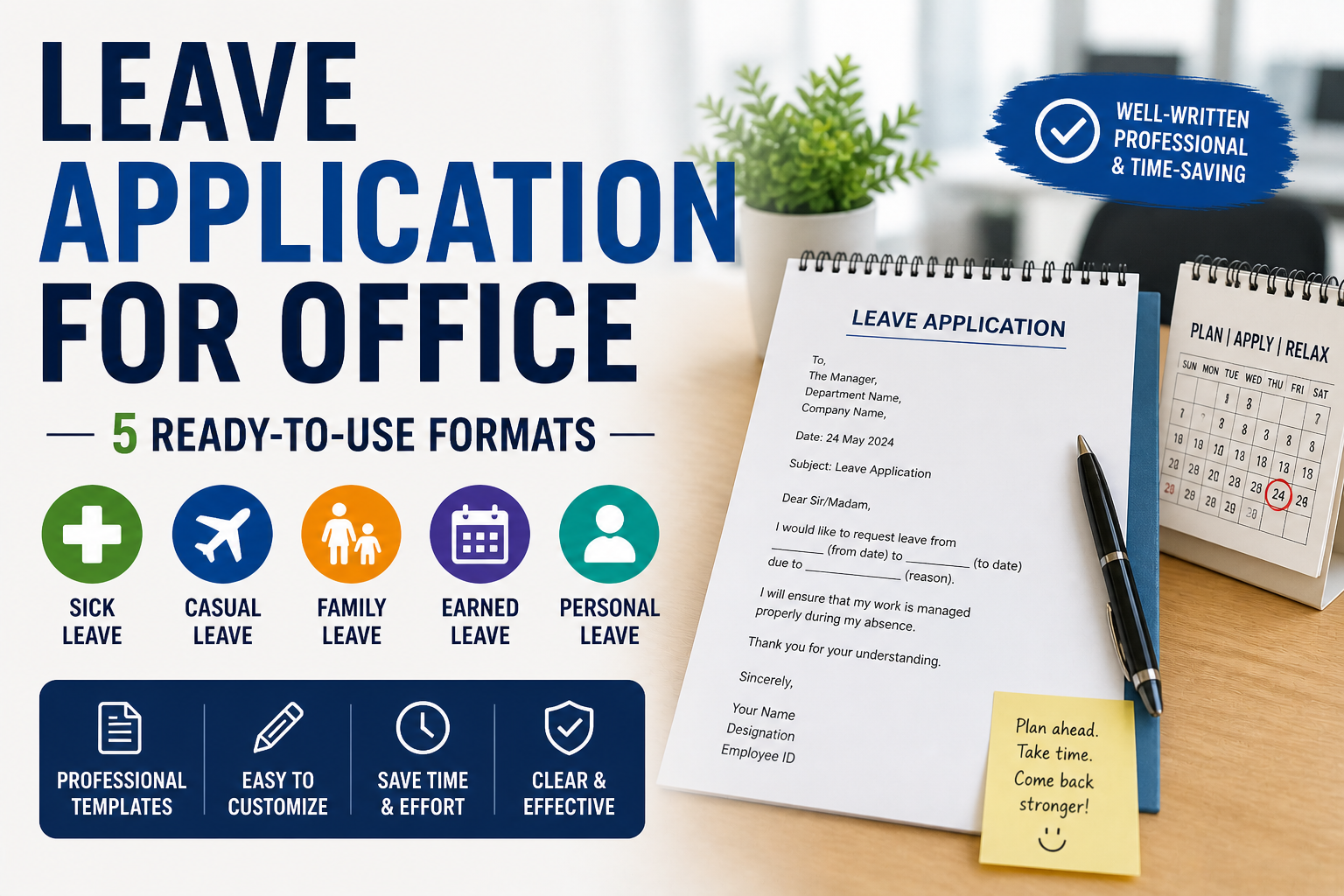
In this complete guide, you will find five ready-to-use leave application formats for different workplace situations, a clear explanation of the different types of leave, a step-by-step writing guide, and the most commonly asked questions about writing leave applications professionally.
1. Types of Office Leave You Should Know
Different types of leave require different kinds of applications. Understanding what each type is — and how to frame your request — helps you write a more appropriate and convincing application from the start.
| Leave Type | When to Use It | Typical Notice Required |
|---|---|---|
| Annual / Casual Leave | Planned vacation, personal errands, rest days | 3–7 days in advance |
| Sick Leave | Illness, medical appointments, recovery | Same day or day before |
| Emergency / Urgent Leave | Family emergencies, accidents, sudden events | Immediately, with follow-up |
| Maternity / Paternity Leave | Childbirth or newborn care | 6–8 weeks in advance (if planned) |
| Bereavement Leave | Death of an immediate family member | As soon as possible |
| Half-Day Leave | Personal appointments, errands, half-day plans | Same day or 1 day in advance |
| Work From Home Request | Mild illness, travel, personal circumstances | 1–2 days in advance |
Always check your company’s leave policy or employee handbook before submitting your application. Many organisations have specific rules about notice periods, the documentation required (e.g., a doctor’s note for sick leave), and the chain of approval you must follow.
2. Key Elements of a Leave Application
- To (Recipient): Address the application to your direct manager or HR — whoever your policy specifies.
- From (Your name and designation): Clearly state who you are, especially in larger organisations.
- Date of writing: The date on which you are submitting the application.
- Subject line: A clear, specific subject — e.g., “Leave Application — 3 Days Annual Leave (May 5–7, 2026).”
- Type of leave: Specify what kind of leave you are requesting clearly at the top.
- Leave dates: State the exact start and end dates, and the total number of days.
- Reason: A brief, professional explanation — you do not need to over-explain or make it personal.
- Work coverage: Note how your responsibilities will be handled in your absence (handover colleague, completion before leave, etc.).
- Request for approval: End with a polite request for the manager’s approval or acknowledgment.
3. Step-by-Step: How to Write a Leave Application
Check Your Company’s Leave Policy First
Before writing anything, confirm how many leave days you have available, how much notice your company requires for the type of leave you need, and whether approval must come from your manager, HR, or both. This prevents submitting a request that goes to the wrong person or creates a policy conflict.
Write a Clear, Specific Subject Line
Your manager likely receives dozens of emails daily. A clear subject line like “Leave Application — Annual Leave, May 12–16, 2026” tells them immediately what this email requires and allows them to prioritize it properly. Vague subjects like “Time Off Request” are easily overlooked.
State Your Request in the First Sentence
Do not make your manager read three paragraphs before they understand what you are asking for. Open with a direct statement: “I am writing to request three days of annual leave from Monday, May 12, to Wednesday, May 14, 2026.” Everything else in the letter supports this opening statement.
Give a Brief, Professional Reason
You do not need to share every detail of your personal situation — and many people prefer not to. A brief professional reason is sufficient: “family commitment,” “personal matter,” “medical appointment,” or “planned family vacation.” For emergencies, a single honest sentence about the urgency is entirely acceptable.
Address Work Coverage Proactively
This is the element most employees forget — and the one that most influences whether managers approve a leave request smoothly. Tell your manager who will cover your responsibilities, what work you have completed before leaving, or how urgent matters can be reached in your absence. Taking this initiative demonstrates professionalism and reduces your manager’s concern about the impact of your absence.
Submit Early and Follow the Right Channel
Submit your application via the channel your company uses — email, HR portal, or physical form. For planned leave, submit it as early as possible. For urgent situations, send the application as soon as you are able, even if that is the same morning. A late application always draws more scrutiny than an early one.
4. Five Ready-to-Use Leave Application Formats
Format 1 — Annual / Casual Leave Application
To: [Manager’s Name / HR Manager’s Name]
From: [Your Full Name], [Your Designation / Department]
Date: [Today’s Date]
Subject: Leave Application — Annual Leave, [Start Date] to [End Date]
Respected [Sir / Ma’am / Name],
I am writing to respectfully request [number] days of annual leave from [start date] to [end date] (inclusive), due to [briefly stated reason: e.g., a planned family vacation / personal commitments / a family event].
I have ensured that all pending work has been completed prior to my leave. In my absence, [colleague’s name] has kindly agreed to handle any urgent matters that may arise, and I will be reachable in the event of an emergency.
I kindly request your approval for this leave. Please let me know if any further information is required.
Thank you for your consideration.
Sincerely,
[Your Full Name]
Format 2 — Emergency / Urgent Leave Application
To: [Manager’s Name]
From: [Your Full Name], [Designation]
Date: [Today’s Date]
Subject: Urgent Leave Application — [Date(s)]
Respected [Sir / Ma’am],
I am writing to inform you that due to an urgent [family emergency / medical emergency / personal matter requiring immediate attention], I am unable to attend work today and possibly on [specific dates if known] as well.
I deeply regret the short notice and the inconvenience this may cause. I have informed [colleague’s name] about my pending responsibilities, and they have agreed to assist in my absence. I will remain reachable via phone for any critical matters.
I will submit any required documentation upon my return. I sincerely request your understanding and approval for this urgent leave.
Respectfully,
[Your Full Name]
Format 3 — Maternity / Paternity Leave Application
To: [HR Manager / Department Head]
From: [Your Full Name], [Designation, Department]
Date: [Today’s Date]
Subject: [Maternity / Paternity] Leave Application
Dear [Manager’s Name],
I am writing to formally request [maternity / paternity] leave in accordance with the company’s leave policy. My expected leave period is from [start date] to [end date] — a total of [number] weeks.
I intend to complete all current projects and ensure a proper handover of my responsibilities before my leave begins. I have already begun briefing [colleague’s name], who will manage my key duties during my absence. I will also prepare a detailed handover document and share it with you before my last working day.
I am grateful for the company’s support policy and appreciate your consideration of this request.
Sincerely,
[Your Full Name]
Format 4 — Half-Day Leave Application
To: [Manager’s Name]
From: [Your Name], [Designation]
Date: [Today’s Date]
Subject: Half-Day Leave Application — [Date]
Dear [Manager’s Name],
I would like to request a half-day leave on [date], specifically for the [morning / afternoon] session, due to [medical appointment / personal commitment / family matter].
I will ensure that all ongoing work is up to date before I leave, and I will be available by phone for any urgent queries during my absence.
I request your kind approval for this half-day leave. Thank you.
Regards,
[Your Full Name]
Format 5 — Bereavement (Death in Family) Leave Application
To: [Manager’s Name / HR]
From: [Your Full Name], [Designation, Department]
Date: [Today’s Date]
Subject: Bereavement Leave Application
Dear [Manager’s Name],
It is with deep sadness that I inform you of the passing of my [relationship: e.g., father / mother / grandmother] on [date]. I am writing to request bereavement leave from [start date] to [end date] to be with my family and attend the funeral proceedings.
I understand this is a difficult time to be away, and I have arranged for [colleague’s name] to manage the most urgent of my responsibilities during this period.
I would be grateful for your compassionate consideration of this request. I will provide any required documentation upon my return.
Respectfully,
[Your Full Name]
5. Tips for Getting Your Leave Approved Quickly
- Apply as early as possible: Advance notice shows planning and gives your manager time to arrange coverage without stress.
- Avoid peak periods: Requesting leave during high-workload periods (e.g., month-end, major project deadlines) reduces approval chances. If unavoidable, explain the urgency clearly.
- Sort out your handover before you ask: Naming a colleague who has agreed to cover your responsibilities is the single most effective way to get a quick “yes.”
- Be specific about your return date: “I will return on Monday, May 19” is clearer and more reassuring than “I’ll be back next week.”
- Keep the reason brief and professional: You do not need to justify personal time off with lengthy explanations. Brief and professional outperforms detailed and over-explained every time.
- Follow up politely if there is no response within 24 hours: A simple “Just following up on my leave request from yesterday — please let me know if you need any further information” is entirely appropriate.
6. Frequently Asked Questions About Leave Applications
A Well-Written Application Gets the Yes — Every Time.
A professional leave application doesn’t have to be complicated. Be clear, be early, handle your handover, and keep your tone respectful. Use any of the five formats above as your starting point, personalize it to your specific situation, and submit it through the right channel. Your manager will appreciate the professionalism — and your leave will be approved without friction.