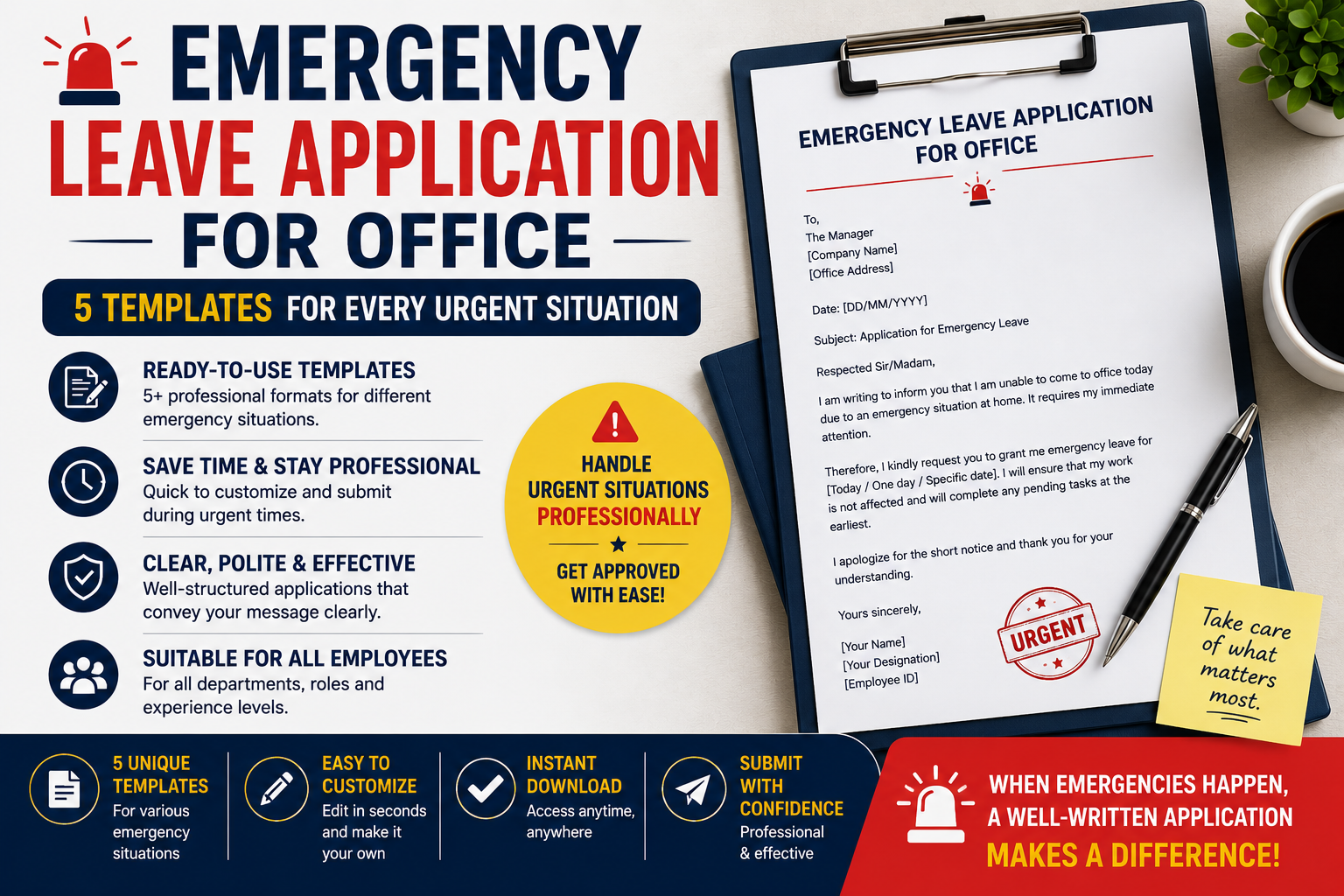
Emergency Leave Application for Office — 5 Templates for Every Urgent Situation (2026)
When an emergency strikes, you need the right words fast. These templates help you communicate professionally under pressure.
5 Copy-Ready TemplatesFamily & Medical EmergenciesUpdated June 20269 min read
Quick Answer: An emergency leave application for the office should be sent as soon as you are aware of the emergency — even a brief initial message is better than nothing. Include your name, the date, the reason (as much detail as you are comfortable sharing), the expected duration of your absence, who will handle your responsibilities, and your contact details. A formal written application can follow once the immediate crisis has passed.
Emergency leave — sometimes referred to as compassionate leave or urgent personal leave — is a type of workplace leave granted when an employee faces an unexpected, serious situation that requires their immediate attention and makes it impossible for them to come into work with advance notice. By its very nature, emergency leave cannot always be planned in advance, and most reasonable employers understand this.
Situations That Typically Qualify as Emergency Leave
Family emergency: A sudden serious illness, accident, or hospitalisation of a close family member — spouse, parent, child, or sibling — that requires your physical presence or urgent support.
Medical emergency: Your own sudden illness or medical condition that prevents you from attending work and requires immediate treatment.
Accident: A road accident, home accident, or any other incident involving yourself or an immediate family member that requires urgent attention.
Natural disaster: Flooding, fire, or another natural event that affects your home or requires your immediate response to protect your family and property.
Bereavement: The death of a close family member or loved one. This is one of the most universally recognised grounds for emergency or compassionate leave across all organisations and cultures.
Sudden illness of a dependent: A child, elderly parent, or other dependent who requires your urgent care due to sudden sickness — particularly if no alternative caregiver is available.
What Is Generally Not Emergency Leave
It is equally important to understand what most organisations do not classify as emergency leave. Planned medical appointments (even important ones), pre-booked personal commitments, travel disruptions for non-critical journeys, or personal errands that could have been scheduled outside office hours generally do not qualify as true emergency leave. Using emergency leave for non-emergencies erodes trust and can have consequences if the pattern continues. For these situations, a standard or casual leave application is more appropriate.
2. Your Rights Around Emergency Leave
Understanding your rights before an emergency occurs — not during one — puts you in a far stronger position to handle the situation professionally and confidently.
Most reputable organisations have a formal emergency leave or compassionate leave policy documented in their employee handbook. This policy typically outlines how many days of emergency leave are permitted, whether it is paid or unpaid, what documentation may be required upon return, and the process for notifying the organisation during an emergency.
In many countries, there are also legal protections for employees who need to take time off for genuine family emergencies or bereavements. Labour laws in the UK, Australia, Canada, and many other jurisdictions include provisions for dependant care leave or bereavement entitlements. In other regions, the entitlement is driven by company policy rather than statute.
Important: Whether emergency leave is paid or unpaid varies significantly by organisation and country. Never assume your emergency leave will be paid without first checking your employment contract or HR handbook. Many organisations offer a set number of paid emergency days per year, after which additional time may be unpaid or drawn from your annual leave balance.
The most important step — before an emergency ever happens — is to read your company’s leave policy. Knowing your entitlements in advance means you can act quickly and confidently when a crisis does arise, without having to research your rights at the worst possible moment.
3. How to Apply for Emergency Leave: The Right Process
Because emergencies are by definition unplanned, the process for applying for emergency leave is different from standard leave. Speed of communication is paramount, and formality can follow once the immediate crisis is managed. Here is the right sequence of actions.
Step
What to Do
How Quickly
Step 1
Notify your manager immediately — phone call or message first, before email
As soon as the emergency occurs or becomes known to you
Step 2
Send a formal application (email or written) as soon as you are able
Within the same day if possible, or the following morning
Step 3
Arrange coverage for your most critical work responsibilities
During or immediately after your initial notification to your manager
Step 4
Submit supporting documents if required (medical certificate, death certificate, etc.)
Upon return to the office, or as soon as documents are available
Step 5
Follow up with HR after you return to ensure your leave is formally recorded
On your first day back at the office
💡 Key principle: In an emergency, a short, imperfect message sent immediately is worth far more than a perfect, detailed email sent hours later. Notify first — even two sentences by text or WhatsApp — then follow up with the formal documentation when the situation allows.
4. What Your Emergency Leave Application Must Include
Even in the most urgent of circumstances, a strong emergency leave application should contain the following core elements. For same-day notifications where only a brief message is possible, aim to include at least the highlighted items. A fuller application can follow once you are able to write one.
Element
What to Write
Your name and department
Your full name and the team or department you work in
Date of application
The date on which you are writing the application
Nature of the emergency
A brief, honest description — “a serious family medical emergency”, “bereavement”, “a home emergency”. Share as much or as little as you are comfortable with.
Start date of absence
The date from which your leave begins — often the same day the emergency occurs
Expected duration or return date
An estimate of how long you will be away. If unknown, say so — “I will provide an update on my return date as soon as possible.”
Coverage arrangement
The name of a colleague who has agreed to handle urgent matters in your absence
Contact availability
Whether and how you can be contacted during your absence — your mobile number or preferred contact method
5. How to Write an Emergency Leave Application (Step by Step)
Writing an emergency leave application under stress is challenging. Following this structured approach will help you produce a clear, professional communication — even when your focus is rightfully elsewhere.
1
Notify immediately — even imperfectly
Your first action should be to contact your manager as soon as the emergency is known to you. A phone call is ideal. If calling is not possible, send a WhatsApp message or text immediately. Do not wait until you have time to write a perfect email — time matters most at this stage.
2
State the emergency clearly but concisely
In your formal application, describe the nature of your emergency clearly enough that your manager understands the seriousness of the situation. You are not obligated to provide extensive personal details, but enough context should be given that your request is clearly legitimate and urgent.
3
Give your best estimate of the duration
Even if you are uncertain how long you will be away, provide your best estimate and commit to updating your manager as the situation develops. This shows professionalism and consideration for the team’s planning. “I estimate I will need 3–5 days” is far more useful than “I don’t know when I’ll be back.”
4
Name your coverage contact
Identify by name the colleague who has agreed to handle your most time-sensitive responsibilities during your absence. If you were unable to arrange this before leaving, do so via a brief call or message to your colleague as soon as possible, and mention this in your application.
5
Close with contact details and an apology for the disruption
End your application with your mobile number, an acknowledgement of the inconvenience your absence causes, and gratitude for your employer’s understanding. A brief, sincere closing goes a long way in maintaining goodwill, particularly when you return to the workplace.
6. Emergency Leave Application Templates
The following five templates cover the most common emergency leave scenarios. Each is written to be professional, empathetic, and appropriate for office communication under pressure. Replace the highlighted placeholders with your own details before sending.
Template 1Family Emergency (General)
Subject: Emergency Leave Application — [Your Name] — Effective Immediately
Dear [Manager’s Name],
I am writing to request emergency leave with immediate effect, commencing today, [Date]. I am dealing with a serious family emergency that requires my full attention and physical presence.
I anticipate being away from the office for approximately [X days / until further notice]. I will keep you updated as the situation develops and will provide a clearer return date as soon as I am able to.
I have informed [Colleague’s Name] of my urgent assignments and have asked them to handle the most time-sensitive matters in my absence. I will be reachable on my mobile at [phone number] for any genuinely critical issues.
I apologise for the disruption this causes and appreciate your understanding during this difficult time.
Sincerely,
[Your Full Name][Department / Job Title]
Template 2Medical Emergency
Subject: Emergency Medical Leave — [Your Name]
Dear [Manager’s Name],
I am writing to inform you that I require emergency leave due to a medical emergency that arose unexpectedly [this morning / last evening]. I am currently [receiving treatment / accompanying a family member who is receiving urgent medical care].
I expect to be absent from [Date] for approximately [duration]. I will provide a medical certificate upon my return as required by company policy.
[Colleague’s Name] is aware of my current workload and will manage urgent matters in my absence. Please feel free to contact me at [phone number] for anything that cannot wait.
I appreciate your understanding and will update you on my expected return as soon as possible.
Best regards,
[Your Full Name][Employee ID — if applicable]
Template 3Bereavement / Death in the Family
Subject: Bereavement Leave Request — [Your Name]
Dear [Manager’s Name],
It is with deep sadness that I inform you of the passing of my [relationship — e.g., father / grandmother / close family member]. I am writing to request compassionate leave from [Start Date] to [End Date] to be with my family during this time and to attend the funeral arrangements.
I have briefed [Colleague’s Name] on my most urgent responsibilities. I will have limited access to email during this period but will be available in genuine emergencies at [phone number].
I appreciate the sensitivity with which I trust this will be handled, and I am grateful for the company’s compassionate leave policy.
Yours sincerely,
[Your Full Name][Department]
Template 4Retroactive Emergency Leave Application (Written After the Emergency)
Date: [Date of Application]
To: [Manager’s Name / HR Department]
From: [Your Full Name], [Job Title]
Subject: Retrospective Emergency Leave Application — [Dates of Absence]
Dear [Manager’s Name],
I am writing to formally document and request approval for the emergency leave I took from [Start Date] to [End Date]. As you are aware, the situation was [brief explanation] and arose without any opportunity for advance notice.
I understand that a formal application was not submitted before my absence. I apologise for this and am submitting this application retrospectively to ensure my leave is properly recorded. I have attached [supporting documents — medical certificate / police report / other relevant documentation] as required.
I am happy to discuss this further if needed. Thank you for your understanding during a very difficult period.
Yours faithfully,
[Your Full Name][Department / Employee ID][Date]
Template 5Quick WhatsApp / Text Emergency Notice
Hi [Manager’s Name], I am so sorry but I have a family/medical emergency and will not be able to come in today / for the next few days. I will send you a proper email as soon as I am able. [Colleague’s Name] can cover urgent matters. I apologise for the inconvenience and will be in touch as soon as possible. — [Your Name]
7. Common Mistakes to Avoid
Even in a crisis, the way you communicate your absence has a lasting impact on how you are perceived professionally. Avoiding these mistakes will help you return to the workplace with your professional reputation intact.
❌
Disappearing without any notification at all. This is the most serious mistake an employee can make. Even if you are in the middle of a severe crisis, sending a two-sentence WhatsApp message to your manager takes under a minute and prevents your absence from being recorded as unauthorised. There is almost no situation where some form of notification is genuinely impossible.
❌
Providing no contact information during the emergency. Your manager and team may need to reach you for something that only you can address. Even if you cannot take calls freely, sharing your phone number and specifying the best times to reach you shows professionalism and keeps the team connected when it matters most.
❌
Not arranging work coverage before or immediately after leaving. Leaving your team without a plan for handling your responsibilities creates unnecessary strain and resentment. Even a quick text or call to a trusted colleague — “Can you keep an eye on X while I’m away?” — is enough to ensure continuity and demonstrates your commitment to the team even in a difficult moment.
❌
Failing to submit a formal application after the initial emergency message. A WhatsApp message to your manager is not a formal leave application. Once the immediate crisis has stabilised, send a proper written application — email or formal letter — so that your absence is correctly documented in your HR records. Failing to do so can result in your leave being classified as unauthorised.
❌
Not providing documentation when required by company policy. Many organisations require a medical certificate, death certificate, or other supporting document when you return from emergency leave. Check your HR policy in advance and gather the necessary documentation while you are away if possible, so you are prepared on your first day back.
❌
Overstating or exaggerating the emergency. This is perhaps the most damaging long-term mistake. If it ever comes to light that the emergency was exaggerated or fabricated, the breach of trust is extremely difficult to repair and can have serious disciplinary consequences. Be honest — most genuine emergencies, described accurately, will receive a sympathetic response from any reasonable manager.
8. Frequently Asked Questions
In most jurisdictions, employers cannot legally deny emergency or compassionate leave for genuine family crises, bereavements, or medical emergencies, particularly when proper notice is given. However, whether such leave is paid or unpaid depends on your employment contract and local labour law. Check your employee handbook and, if necessary, seek advice from your HR department or a labour authority in your country.
Emergency leave duration varies by company policy and country. Most organisations allow between 3 and 7 days for bereavement or serious family emergencies. Medical emergencies may require longer, supported by a doctor’s certificate. Always check your specific company policy — your HR handbook will specify the entitlement. If you need more time than your policy allows, discuss this openly with your manager rather than extending your absence unilaterally.
Many employers require supporting documentation — such as a medical certificate, death certificate, hospital admission record, or similar — upon your return. This is standard practice and is not a sign of distrust. Check your company’s leave policy in advance so you know what is required before you return. If gathering documentation during the emergency is difficult, inform your manager and HR department and provide it as soon as it becomes available.
Contact the next available person in your reporting line — your manager’s manager, or your HR department. Send a text or WhatsApp message first if calling is not possible, then follow up with an email as soon as you are able. Always leave a paper trail, even if it is a short message. The key principle is: notify someone in authority as quickly as possible, regardless of the channel.
Not always. Emergency leave (sometimes called compassionate leave) typically covers urgent family situations, bereavements, and domestic emergencies. Sick leave specifically covers your own illness or medical condition. Some companies have a combined ’emergency leave’ category that covers both, while others maintain them separately. Always refer to your company’s specific leave policy to understand the distinction and ensure you are applying under the correct leave category.
The DMessages team specialises in professional communication templates and workplace writing guides. Our templates are researched, reviewed, and updated regularly to reflect current professional standards across industries and regions.
During a crisis, communication is everything.
Use the template that fits your situation, send it as soon as you can, and focus on what matters most — your family and your wellbeing.