
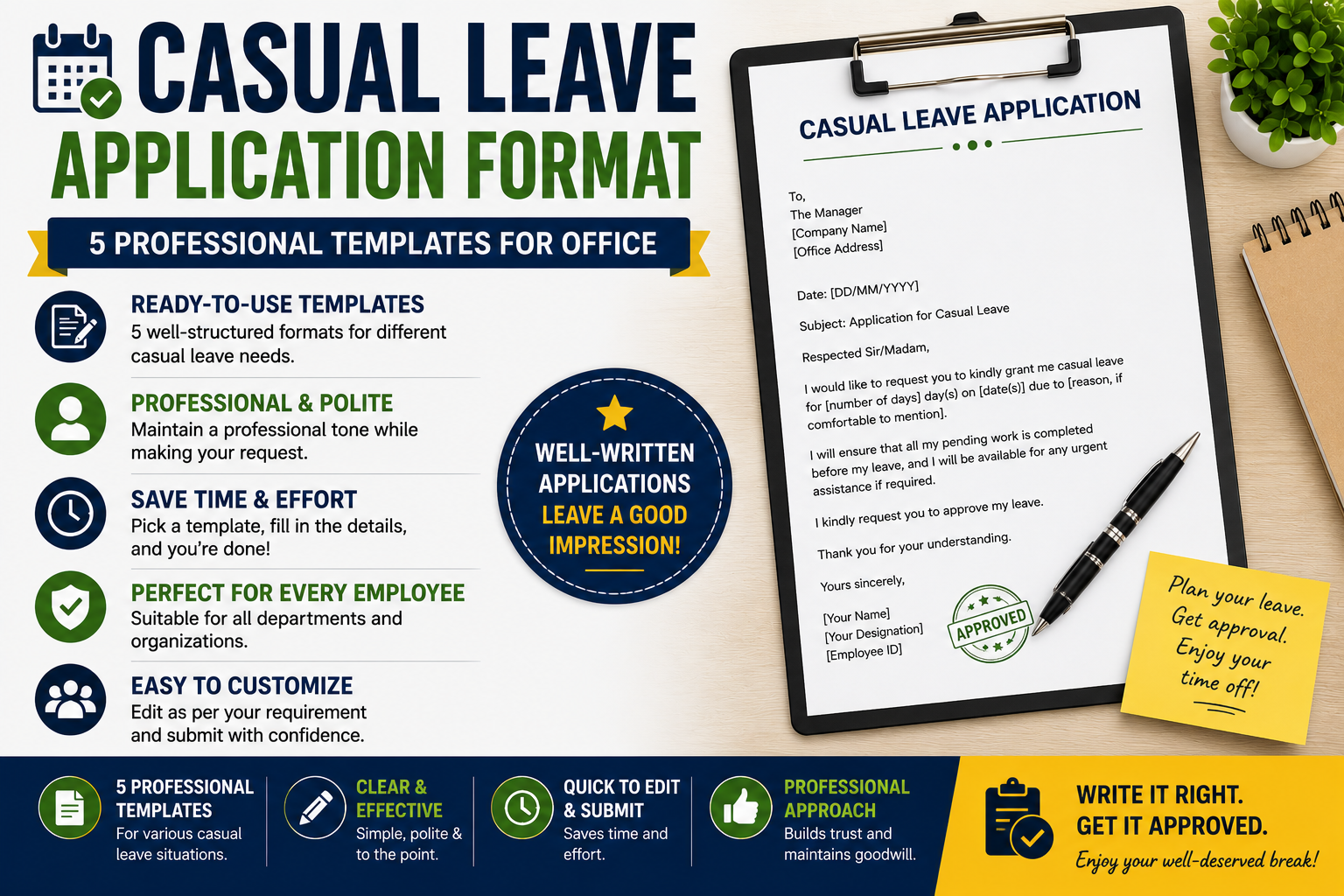
Casual Leave Application Format
5 Professional, Copy-Ready Templates for Every Office Situation — 2026
Casual leave is one of the most frequently used types of employee leave — and yet, one of the most commonly mishandled when it comes to written applications. Whether you need a day off for a personal errand, a family commitment, or simply to recharge, knowing the right casual leave application format is an essential workplace skill. A poorly worded or improperly structured leave application can create unnecessary friction with your manager, delay approval, or even be denied outright — not because the request was unreasonable, but simply because it was presented incorrectly.
In most organisations, casual leave is a distinct category of leave separate from sick leave, earned leave, or annual leave. It is typically granted for short, unplanned, or personal absences and does not usually require formal medical documentation. Most full-time employees are entitled to between 8 and 12 days of casual leave per year, though this varies by country, industry, and employer policy. Despite this entitlement, many employees are unsure how to write a proper application — especially when the reason is personal and they do not wish to disclose too many details.
A good casual leave application does several things at once: it formally notifies your employer, provides just enough context without oversharing, demonstrates professionalism, and reassures your manager that your absence will not disrupt the team. Whether you are writing a quick email for a one-day absence or drafting a formal multi-day leave letter, the format you use sends a message about your professionalism and reliability.
In this guide, you will find the correct casual leave application format for every scenario — from last-minute requests to planned absences — along with five complete, ready-to-use templates, a breakdown of what to include, common mistakes to avoid, and clear answers to the most frequently asked questions.
1. What Is Casual Leave?
Casual leave (often abbreviated as CL) is a type of short-duration, discretionary leave that employees can take for personal, family, or unforeseen matters that do not fall under sick leave or planned annual leave. Unlike earned leave or privilege leave — which is accumulated over time and often requires advance planning — casual leave is intended for situations that arise suddenly or that are personal in nature and do not require official documentation.
The term “casual” reflects the informal or ad hoc nature of the reason. An employee might apply for casual leave to attend a child’s school event, deal with a household emergency, complete a government-related task such as a court appearance or passport appointment, or simply to handle personal matters that cannot be deferred.
Typical Casual Leave Entitlement
In most organisations and government departments, full-time employees receive between 8 to 12 days of casual leave per year. Many companies allow employees to take a maximum of 3 consecutive days of casual leave at one time; anything beyond that typically requires a formal leave application under the annual or earned leave category.
Casual Leave vs. Sick Leave vs. Annual Leave
| Leave Type | Purpose | Documentation | Typical Duration |
|---|---|---|---|
| Casual Leave | Personal / unplanned reasons | Not usually required | 1–3 days at a time |
| Sick Leave | Illness or medical appointments | Medical certificate often needed | Varies |
| Annual / Earned Leave | Holidays, travel, personal time | Prior approval required | Multiple days / weeks |
When Is Casual Leave Appropriate?
- Personal errands (bank visits, government appointments, utility matters)
- Family commitments (school functions, relative visits, domestic events)
- Household emergencies (repairs, unexpected situations at home)
- Religious or cultural observances not covered by public holidays
- Brief personal travel or rest that does not warrant using annual leave
2. Casual Leave Rules and Eligibility
While casual leave is more flexible than other types of leave, it is still governed by company policy and HR guidelines. Understanding these rules before you submit your application can help you avoid a rejection or an awkward conversation with your manager.
| Rule | Details |
|---|---|
| Notice Period | Most organisations require at least 1–2 working days’ notice for casual leave. In emergencies or genuine unforeseen situations, same-day or next-day applications may be accepted at the manager’s discretion. |
| Maximum Consecutive Days | Typically limited to 2–3 consecutive working days. Taking more than this consecutively usually requires shifting to annual or earned leave. Some employers allow up to 5 days with prior approval. |
| Approval Process | Must be approved by the direct line manager and, in some organisations, also notified to HR. Approval is generally at the manager’s discretion and depends on team workload and coverage. |
| Documentation Required | Casual leave typically does not require documentation. However, if combined with weekends or holidays (a “sandwiched” leave situation), some employers may request a brief written explanation. |
| Carryover Policy | Casual leave typically does not carry over to the next calendar or financial year. Unused CL is generally forfeited at year end, unlike earned leave which may be encashable or carried forward. |
| Eligibility | Most permanent and confirmed employees are eligible. Probationary employees may have restricted casual leave entitlements depending on company policy. |
| Frequency Limits | Some organisations have a monthly limit (e.g., no more than 2 days of CL per month). Excessive use of casual leave, even within entitlement, may be flagged during performance reviews. |
3. What Your Casual Leave Application Must Include
Regardless of whether you are sending an email or a formal printed letter, every casual leave application should contain these key elements. Missing any of them can slow down approval or leave your manager uncertain about your plans.
| Element | What to Write | Example |
|---|---|---|
| Date of Application | The date you are writing/sending the application | 20 June 2026 |
| Recipient | Your direct manager’s name and designation | To: Mr. James Harrington, Senior Manager |
| Subject Line | Clear and specific — mention leave type and dates | Casual Leave Request — 23 June 2026 |
| Salutation | Professional greeting using name or designation | Dear Mr. Harrington / Dear Sir |
| Leave Dates | Exact date(s) — start and end date for multi-day requests | 23 June 2026 / 23–25 June 2026 (3 working days) |
| Reason | Brief — personal, family, or specific if you wish to share | “personal commitments” / “a family matter requiring my presence” |
| Work Continuity | Who will cover your responsibilities and how | “Sarah will manage any urgent queries during my absence.” |
| Reachability | Whether you can be contacted in emergencies | “I will be reachable on my mobile at [number] if needed.” |
| Closing & Signature | Professional sign-off with your name, department, employee ID | Best regards, Sarah Ahmed | Operations | EMP-2047 |
4. Step-by-Step: How to Write a Casual Leave Application
Before writing anything, confirm the exact dates you need off and verify that you have sufficient casual leave balance. Log in to your HR portal or check your leave record. This prevents the embarrassment of requesting leave you are not entitled to.
Whether by email or formal letter, your subject line should instantly tell the reader what the message is about. Include the leave type and the specific date(s). For example: “Casual Leave Request — 25 June 2026” or “Application for Casual Leave — 25–27 June 2026.”
You do not need to write a lengthy explanation. One or two sentences are sufficient. If you prefer privacy, “personal reasons” or “personal commitments requiring my presence” is entirely appropriate and professionally accepted. Avoid being vague without acknowledging the nature of the request at all.
This is the most reassuring part of any leave application. Mention whether you have already briefed a colleague, completed pending work, or will prepare a handover note. Managers are far more likely to approve leave when they can see that you have thought about the team’s needs during your absence.
Close the application by formally requesting approval and providing your mobile number or stating that you will be reachable in case of emergencies. Use a professional sign-off (Best regards, Yours sincerely, Thank you) and include your full name, department, and employee ID. This completes the formal record for HR purposes.
5. Five Ready-to-Use Casual Leave Application Templates
Below are five complete, realistic, and immediately usable casual leave application templates. Each one is designed for a different workplace scenario. Click the copy button beneath each template to copy the text to your clipboard, then simply replace the highlighted placeholders with your own details.
6. Common Mistakes to Avoid in a Casual Leave Application
Even with the right format, certain errors can make an otherwise good application look unprofessional or lead to unnecessary delays or rejections. Here are the most common mistakes employees make — and how to avoid them:
7. Frequently Asked Questions About Casual Leave
Not always. In most organisations, stating “personal reasons” is entirely sufficient for casual leave. You are generally not required to disclose the specific nature of personal matters. However, being slightly more descriptive (e.g., “a family commitment”) can make your application feel more complete and may speed up approval. If your company policy requires a reason, a generic phrase is still acceptable.
Technically you can apply for casual leave that is adjacent to a weekend or public holiday, but many organisations have a “sandwich leave” policy. This means that if your casual leave is sandwiched between two non-working days (e.g., taking leave on Friday and Monday, thereby getting four days off), the organisation may count the weekend days as leave as well — or require you to use annual leave instead. Always check your company’s specific leave policy before doing this.
In most organisations, casual leave does not carry forward to the next calendar or financial year. It is a “use it or lose it” type of leave. Unlike earned leave or privilege leave — which can often be accumulated, carried forward, or even encashed — casual leave is forfeited if unused by the end of the leave year. A few companies may allow partial carry-forward, so it is worth checking your specific HR policy before the year ends.
Yes. Even though casual leave is an entitlement, your employer has the right to reject or defer it based on operational requirements — for example, if there is a critical project deadline, a staff shortage, or if too many team members have already applied for leave on the same day. This is why giving advance notice is important: it gives your manager time to plan around your absence rather than being caught off-guard, making approval far more likely.
The maximum consecutive casual leave varies by employer, but the most common limit is 2 to 3 consecutive working days. Taking more than this consecutively generally requires using earned leave or annual leave, which is subject to a different approval process. If you need a longer continuous absence, it is better to discuss options with HR proactively rather than applying only for casual leave and expecting it to be approved for an extended period.
Found the Right Template?
Bookmark this page for future reference — workplace leave situations can change, and having the right format on hand saves you time and stress. Share this guide with a colleague who might need it, and explore our full library of professional letter templates at dmessages.com.