
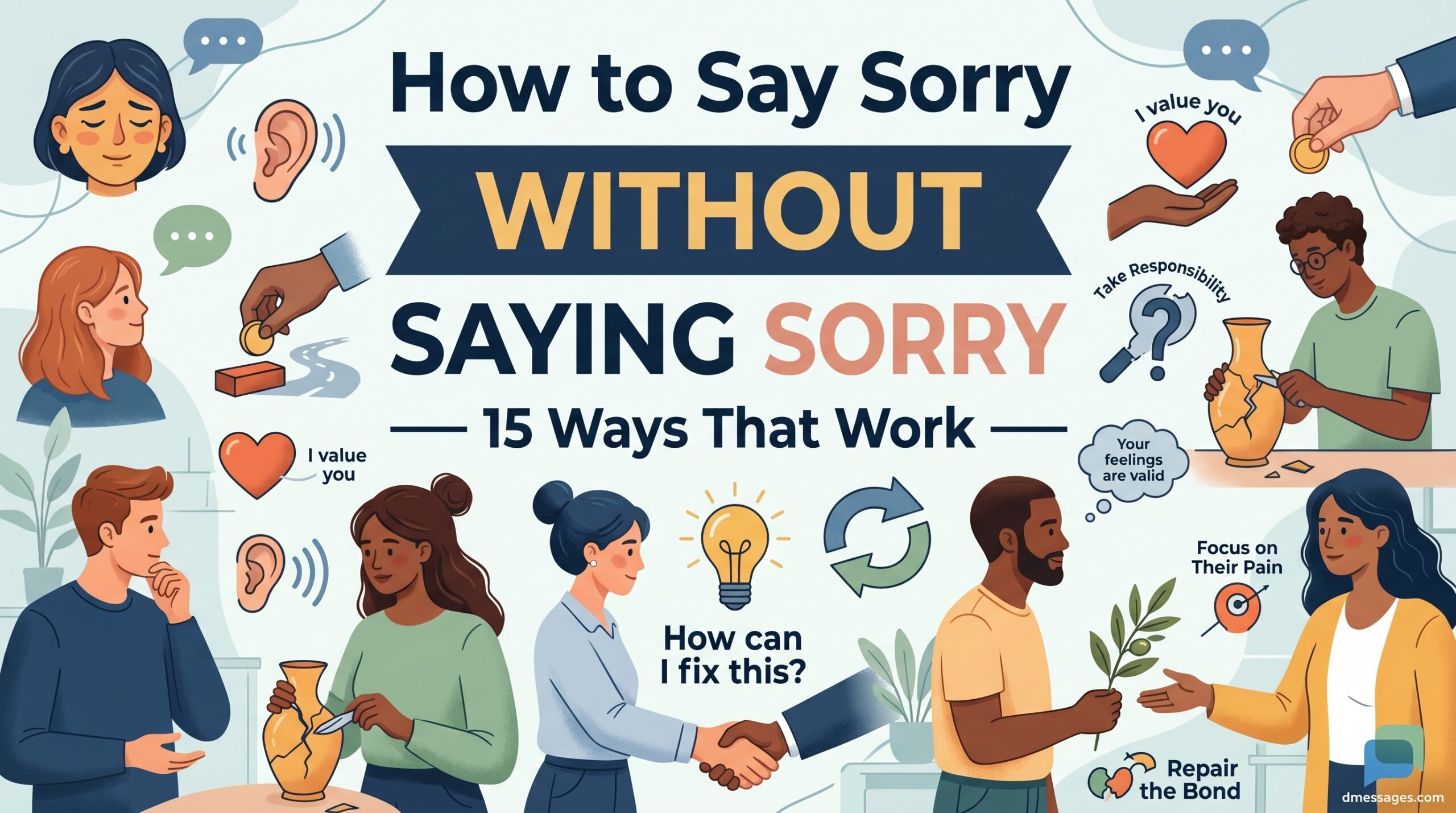
How to Say Sorry Without Saying Sorry —
15 Creative Ways That Actually Work (2026)
Because sometimes actions speak deeper than words — and “I’m sorry” alone isn’t always enough.
There are moments when saying “I’m sorry” simply falls flat — not because the guilt is not real, but because the words themselves have lost their weight. Maybe you have already apologized too many times and they no longer trust the phrase. Maybe the other person has shut down completely and is not ready to hear anything from you yet. Maybe you find it genuinely difficult to say those words out loud, but you want your remorse to feel like something real — not just a reflex.
Learning how to say sorry without saying sorry is not about dodging accountability. On the contrary, it is about expressing remorse in a way that is felt, not just heard. Thoughtful actions, carefully chosen words, and meaningful gestures can — in many situations — communicate what “I’m sorry” alone never could.
In this guide, you will find 15 meaningful, creative ways to apologize without using the word “sorry” — along with 8 ready-to-use message templates you can send right now to express genuine remorse in your own words.
1. Why “I’m Sorry” Isn’t Always Enough
The phrase “I’m sorry” is one of the most commonly spoken — and most frequently empty — phrases in the English language. Consequently, many people have heard it so many times from someone who never changed their behavior that it has lost almost all meaning. If you find yourself in a situation where the words are not working, you are not alone — and you are not out of options.
Here are the most common reasons why a simple verbal apology falls short:
- You’ve said it too many times: If “sorry” has become a pattern without behavioral change, the other person has stopped hearing it as sincere.
- They won’t listen right now: The hurt is too fresh, and they have emotionally shut down. Words in this state rarely reach anyone.
- The situation requires action, not words: Some mistakes can only be fixed by doing something — not saying something.
- You struggle with verbal expression: Some people simply communicate far more effectively through actions and written words than through speech.
- You need to show — not just tell: For rebuilding deep trust, behavioral consistency over time matters far more than any spoken apology.
- The relationship needs healing, not debate: Sometimes bringing up the words “I’m sorry” re-opens the argument rather than closing it.
In all of these situations, knowing how to express genuine remorse through alternative means is not weakness or avoidance — it is emotional intelligence. Furthermore, it often produces a far more lasting repair of the relationship than the words alone ever could.
2. 15 Ways to Say Sorry Without Saying Sorry
Each of the following methods is a genuine, sincere way to show remorse and communicate accountability — without ever needing to say the two-word phrase. Use one, or combine several, depending on the depth of the situation and how well you know the person.
Write Them a Heartfelt Letter or Note
Sit down — away from distractions — and write everything you feel. Be specific about what you did, acknowledge how it affected them, and express your genuine commitment to doing better. You do not have to use the word “sorry” once. A thoughtful letter, delivered by hand or sent quietly, shows more care and effort than any rushed verbal apology. It also gives them something they can re-read privately, when they are ready to absorb it.
Listen to Them — Fully and Without Defending Yourself
One of the most powerful forms of apology is simply sitting with someone and letting them speak. Look them in the eyes. Do not interrupt. Do not explain yourself. Do not prepare a response while they are still talking. Just listen — genuinely, patiently, and without condition. When they finish, saying “I hear you, and what you felt is completely valid” communicates more sincere remorse than a dozen apologetic phrases.
Fix What You Broke
If you broke something, replace it. If you missed an obligation, make it up. If you caused financial harm, address it. If you said something publicly hurtful, correct it publicly. Taking direct, concrete steps to repair the damage caused by your actions says “I’m sorry” more powerfully than any phrase ever can. Moreover, it shows that you understand the real-world impact of what you did — not just how it made them feel emotionally.
Give Them Space — Without Being Asked Twice
If the person clearly needs time alone, give it without protest, guilt-tripping, or bombarding them with follow-up messages. Voluntarily respecting someone’s need for space — without being chased into it — communicates something important: that you value their healing more than your own discomfort with the silence. Patience is, in itself, a form of apology.
Do Something Thoughtful and Specific to Them
Think of something meaningful specifically to this person — not a generic gesture, but something that proves you pay attention to who they are. Cook their favorite meal. Pick up something they mentioned wanting weeks ago. Handle a task they have been putting off. These specific acts communicate “I see you, I think about you, and I am making an effort to show it” without a single word of apology needed.
Use Language That Centers Their Feelings
Instead of “I’m sorry,” use clear, direct language that acknowledges your wrongdoing and validates their experience. Phrases like “I was wrong, and you have every right to feel hurt,” or “What I did was not okay, and I take full responsibility for it” carry the same weight as “sorry” — but feel far more deliberate and accountable. These phrases work in person, in a text, and in a letter.
Send a Voice Note Instead of a Text
If speaking face to face feels too charged right now, a voice note carries the warmth, tone, and sincerity that a text message simply cannot replicate. Hearing your voice — calm, honest, and undefensive — can reach the other person in a way that typed words rarely do. Keep it short, genuine, and completely free of any self-justification.
Change Your Behavior — Permanently
The single most powerful apology you can ever give anyone is to never repeat the behavior that caused the hurt. Sustained, consistent change — demonstrated not for a week but over months — is the answer to every “I’m sorry” that words alone could never deliver. As a result, when the person eventually sees the change, they do not just hear the apology — they feel it in how you treat them every single day going forward.
Help Them Without Being Asked or Expecting Credit
Notice something they need and quietly take care of it — without announcing it, without making it into a gesture, and without expecting them to say thank you. Simply show up and help. This subtle, unprompted act of care communicates “I am paying attention to you, and your wellbeing matters to me” in a language that goes far deeper than words.
Remind Them of Your Shared Bond
If the relationship has history, gently remind them of it — not to deflect from the current situation, but to place the mistake in the larger context of your connection. Something like: “I’ve been thinking about how much you mean to me, and I realize that what I did was completely at odds with the kind of person I want to be to you.” This approach works especially well in close friendships or long-term romantic relationships.
Send a Song That Says What You Cannot
Music communicates emotion in a way that ordinary language often cannot. If there is a song that perfectly captures how you feel — your regret, your love for the person, your awareness of what you did — send it with a brief, honest note explaining why you chose it. This is especially effective for partners, close friends, or family members who share a musical connection with you.
Plan a Meaningful Experience Together
For a close relationship, planning something special — a day out, a shared meal, an activity they have always wanted to try — communicates an important message: you value the time you share, and you want to create something good between you rather than let the hurt linger. It is an open, gentle invitation back into connection.
Send Flowers, a Handwritten Card, or a Small Meaningful Gift
A physical gesture — chosen thoughtfully and not extravagantly — breaks silence in a way words sometimes cannot. Attach a handwritten card that expresses your remorse in your own words, without ever using the word “sorry.” The combination of a tangible gesture and a personal, specific note makes the apology feel real and deliberately given.
Be Consistent — Show Up Every Day
If the hurt was deep, one grand gesture will not repair it. In fact, grand one-off gestures can sometimes feel performative. What truly rebuilds trust is the quiet, unglamorous commitment of showing up consistently — being patient, attentive, honest, and kind — day after day, without needing to be thanked for it. This is the sustained “I’m sorry” that eventually heals even very deep wounds.
Be There When They Need You Most
After you have hurt someone, one of the most meaningful things you can do is simply be there for them when they need support — without making it about you, without expecting it to “fix” things, and without using it as leverage. Answering their call. Showing up when they are struggling. Being reliable without any agenda. This kind of presence, offered sincerely after a period of hurt, can communicate more love and remorse than any phrase ever could.
3. 8 Messages That Express Remorse (Without the Word “Sorry”)
Sometimes you need the right words immediately — for a text message, a short note, or a voice message. Below are 8 ready-to-use messages that express genuine remorse and accountability without using “I’m sorry” at all. Personalize them with your own details before sending.
Message 1 — General (Text or Note)
I’ve been thinking a lot about what happened, and I need you to know — I was wrong. What I did wasn’t fair to you, and you didn’t deserve it. I’m not going to make excuses. I own it completely. Take all the time you need. I just didn’t want another day to pass without you knowing that I understand what I did, and I genuinely want to do better.
Message 2 — For a Partner or Girlfriend / Boyfriend
I know you’re hurting right now, and I know that the person responsible for that pain is me. I don’t want to fill your phone with words that feel hollow. I just want you to know that you are the most important person in my life, and losing even a piece of your trust is something I take with complete seriousness. I’m here. I’m not going anywhere. And I will show you — not just tell you — how much you mean to me.
Message 3 — For a Best Friend
You don’t have to respond to this right now. I just needed to reach out and be honest with you — I was wrong, and what I did wasn’t the kind of friend I want to be to you. Our friendship means more to me than I think I’ve ever shown properly. I’m giving you the space you need, but I want you to know I’m here whenever you’re ready. I’m not going anywhere.
Message 4 — For a Family Member
I’ve been sitting with what happened between us, and there’s something I need to say. I was wrong. The way I acted was unfair to you, and you deserved better from someone who loves you as much as I do. I know that words are easy. I’m not just saying this — I genuinely mean it, and I’m committed to showing it through how I treat you going forward. You matter to me more than any argument ever could.
Message 5 — For a Colleague (Professional)
I want to acknowledge what happened and take full responsibility for my part in it. What I did was not appropriate, and it put you in an unfair position. I’ve reflected on it, and I understand why you’re frustrated. I’m committed to handling things differently going forward. I genuinely value working with you, and I hope we can move past this.
Message 6 — Deep & Emotional (For Someone Seriously Hurt)
I’m not going to pretend that saying the right words is enough after what I did. I know it isn’t. What I want you to know is that I see it clearly — what I did, how it affected you, and why it was wrong. I’m not making excuses. I’m not asking you to respond. I just need you to know that I carry this, and that I am genuinely working to be better — not for my sake, but because you deserve more than what I gave you.
Message 7 — Short and Honest (WhatsApp or Text)
I know I was wrong. I know it hurt you. I’m not going to keep filling your inbox — I just wanted you to know that I get it, I own it, and I genuinely want to make it right. Whenever you’re ready to talk, I’m here.
Message 8 — For Someone Who Has Stopped Responding
I understand if you’re not ready to respond, and I’m not sending this to pressure you. I just want you to know — plainly and honestly — that I was wrong. You didn’t deserve what happened. I’m going to give you the space you need, and I’ll wait — however long it takes. This friendship / relationship is worth it to me. I hope, when you’re ready, you’ll know that.
4. When Is This Approach the Right Choice?
Knowing when to use an action-based or alternative-wording apology — versus a direct verbal “I’m sorry” — is just as important as knowing how to do it. Not every situation calls for the same approach. Therefore, use the following guide to decide what fits your specific circumstances:
| Situation | Best Approach |
|---|---|
| They won’t speak to or respond to you | A handwritten note or Message 8 above — short, honest, no pressure |
| You’ve verbally apologized multiple times already | Stop saying it — show consistent behavioral change instead |
| The hurt is very fresh and emotions are high | Give space first, then use a thoughtful written message (Messages 1–4) |
| The situation is professional / workplace | Use “I was wrong / I take full responsibility” language (Message 5) |
| You broke something or caused concrete harm | Fix it first, then follow up with a note — actions before words |
| The relationship is long-term and the hurt is deep | Combine a heartfelt letter with sustained change over time |
| The person needs practical support right now | Show up quietly and help — without making it about the apology |
5. What NOT to Do When Saying Sorry Without Saying Sorry
As helpful as these approaches are, there are several common mistakes that completely undercut even the most sincere gesture. In fact, doing any of the following can make things significantly worse:
Don’t use grand public gestures — they make the apology about your performance, not their healing. Keep it private and personal.
Don’t use “I know you’re upset” — this minimizes their feelings. Say instead: “I understand this hurt you deeply.”
Don’t immediately pivot to what they did wrong — the moment you bring up their mistakes, your apology is dead. Keep it entirely about your actions.
Don’t do something nice and then expect immediate forgiveness — gestures are not bargaining chips. They are gifts, freely given.
Don’t over-explain your reasons — explaining why you did it comes across as excusing yourself. Own it, then move on to what you are doing to fix it.
Don’t substitute these methods for a real conversation forever — eventually, both people need to talk. Actions open the door; honest words walk through it.
6. Frequently Asked Questions
Actions Speak Louder. Start with One.
You don’t always need the word “sorry” to communicate genuine remorse. What you do need is honesty, thoughtfulness, and the willingness to show — not just say — that you care about the person you hurt. Pick one method from this guide, personalize it to your situation, and take that first step. The right gesture, given at the right moment with a sincere heart, can open a door that words alone never could.