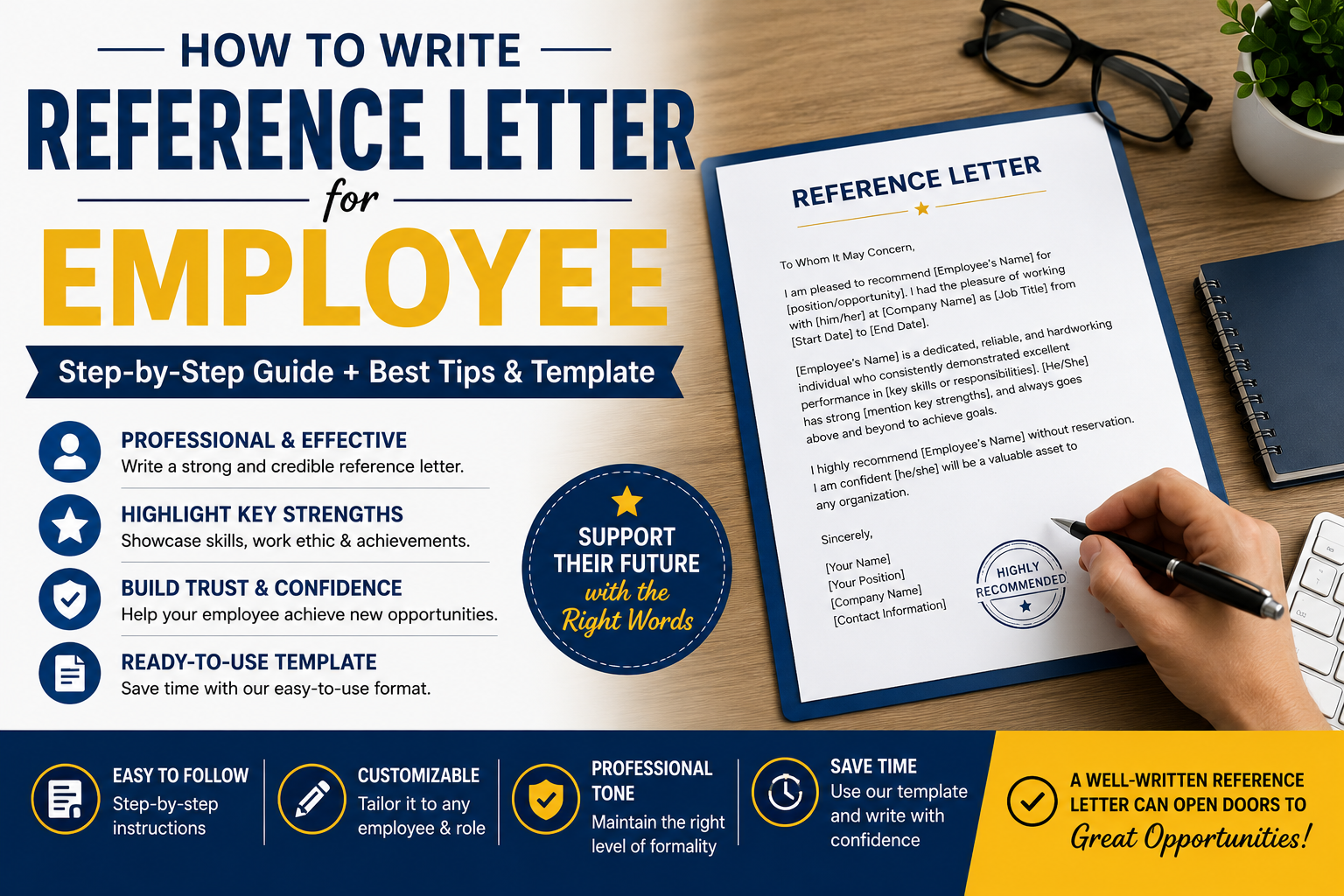
How to Write a Reference Letter for an Employee — 5 Professional Templates (2026)
A strong reference letter can be the deciding factor in someone’s next opportunity. Write one that truly advocates for them.
5 Copy-Ready TemplatesAll Reference TypesUpdated June 202611 min read
An employee has asked you to write them a reference letter. It is a request that carries real weight — the quality of what you write can meaningfully influence whether they land a new job, gain admission to a graduate programme, or secure a professional licence. Too many reference letters are vague, formulaic, and do the employee more harm than good. A well-written reference letter, by contrast, can be the deciding factor in a competitive process.
This guide walks you through everything you need to know: what a reference letter is and when it is needed, which type to write, what to include and what to leave out, a clear step-by-step writing process, and five complete copy-ready templates for every major situation. Whether you are writing your first reference letter or looking to improve the quality of letters you have written before, this guide will help you write something that genuinely advocates for the person asking.
Quick answer: A reference letter for an employee should be written on company letterhead (or with your professional credentials), address the recipient formally, clearly state how you know the employee and for how long, describe their key strengths with specific examples, confirm you recommend them unreservedly, and include your contact details. Keep it to one page — two paragraphs of substance, no more.
1. What Is a Reference Letter and When Is It Needed?
A reference letter — also commonly called a letter of recommendation — is a written endorsement from someone who can vouch for an employee’s professional abilities, character, or both. It provides a third-party perspective that carries weight precisely because it comes from someone who has directly observed the person’s work and conduct over time.
Understanding when and why a reference letter is needed helps you write one that is genuinely useful. Reference letters are used in a wide range of contexts:
New job applications: The most common use case. A prospective employer wants to understand how the candidate performs in a real professional setting, beyond what a CV or interview can reveal.
Internal promotions: Many organisations require a formal reference from a current or recent line manager as part of the internal promotion process, particularly for senior roles.
Academic programmes: Graduate, postgraduate, and professional training programmes increasingly require employer references alongside academic ones, especially for MBA programmes, law school, and similar professional qualifications.
Visa and immigration applications: Immigration authorities in many countries require professional references as evidence of employment history, skills, and character.
Professional licences and regulatory applications: In regulated industries — law, medicine, finance, teaching — obtaining or renewing a licence may require a professional reference attesting to the individual’s conduct and competence.
Reference letters can be general — addressed “To Whom It May Concern” and intended for broad use — or specific, addressed to a named individual or organisation for a particular application. Where possible, a specific letter is always more powerful than a general one, because it demonstrates that the writer engaged seriously with the opportunity being applied for.
Who writes a reference letter matters. The most credible references come from a direct manager or senior colleague who can speak from first-hand professional experience. HR professionals, senior mentors, and long-term professional contacts can also write effective references — particularly for character references or situations where the direct line manager is unavailable or unsuitable.
2. Types of Reference Letters
Not all reference letters serve the same purpose or follow the same format. Identifying the right type of reference letter before you start writing ensures that what you produce is genuinely useful for the employee’s specific situation.
Type
Purpose
Written By
Tone
Professional / Employment reference
Job application
Direct manager or senior colleague
Formal, performance-focused
Character reference
Personal integrity, trustworthiness
Colleague, mentor, community figure
Warm, personal
Skills-based reference
Specific technical or professional skill
Manager or specialist colleague
Precise, evidence-focused
Academic reference
Graduate or postgraduate study
Manager or academic mentor
Formal, achievement-focused
Internal promotion reference
Promotion within same organisation
Current manager
Detailed, specific to role requirements
💡 Always ask first: Before you begin writing, ask the employee what the letter is for, who will read it, and what aspects of their background are most relevant. A reference letter written for a job as a project manager should emphasise different strengths than one written for a graduate programme in data science.
3. What to Include in a Reference Letter
The difference between a reference letter that genuinely helps an employee and one that is politely useless often comes down to specificity. Vague praise is easy to write and easy to discount. Concrete examples, specific achievements, and an unambiguous recommendation — these are what make a reference letter credible and persuasive.
Include ✅
Leave Out ❌
Your full name, title, organisation, and contact details
Vague praise (‘great person,’ ‘hard worker’) without supporting examples
How you know the employee and for how long
Anything you cannot honestly and specifically support
2–3 specific strengths with concrete examples
Salary details or disciplinary history
A clear, unqualified recommendation
Conditional or lukewarm language (‘I believe they could probably succeed’)
An offer to discuss further by phone or email
Irrelevant personal information
Date and your signature
Grammar errors, spelling mistakes, or informalities
One of the most common and damaging mistakes in reference letter writing is what employment professionals sometimes call the “faint praise” problem — a letter that is technically positive but so non-specific that it reads as lukewarm. Experienced hiring managers and admissions officers know how to read between the lines. A letter that says “Jane was a reliable member of the team who completed tasks on time” signals very little, compared to one that says “Jane redesigned our client onboarding process from scratch, reducing average client setup time by 35% and eliminating a persistent source of errors that had affected the team for three years.”
4. Step-by-Step: How to Write a Reference Letter
1
Ask the employee what they need it for — and tailor it
Before you write a single word, find out exactly what the letter is for. What role or programme are they applying to? What qualities is the recipient likely to be looking for? What does the employee want you to emphasise? The more context you have, the more targeted and effective your letter will be.
2
Establish your credibility — explain your role and your relationship
Open the letter by making clear who you are and how you know the employee. State your job title, your organisation, and the nature and duration of your relationship. This context tells the reader how qualified you are to vouch for this person, and in what capacity.
3
Choose 2–3 key strengths and back each with a concrete example
Identify the two or three qualities most relevant to the specific purpose of the letter, and for each one, provide a brief but specific real-world example that illustrates it. Avoid listing a long string of adjectives — two or three well-supported strengths are far more persuasive than ten unsupported ones.
4
Provide a clear, warm recommendation — no hedging
The closing of the letter should contain an unambiguous statement of your recommendation. “I recommend [Name] without reservation” or “I have no hesitation in recommending [Name] for this role” — clear, confident, and unqualified. If you cannot write something at this level, it may be worth having an honest conversation with the employee about whether you are the right person to write their reference.
5
Invite the recipient to contact you for further information
Always include a genuine offer to speak further by phone or email. This signals to the recipient that you are confident in what you have written and willing to stand behind it in a live conversation. Include your direct email and phone number.
6
Sign formally and include all your contact details
Close with your full name, job title, and organisation — even if these appear in the header. Add your email address and phone number. For printed letters, sign in ink. For emailed letters, a typed sign-off is acceptable but a scanned or digital signature adds credibility.
5. Five Reference Letter Templates
Below are five complete, copy-ready reference letter templates — one for each major situation. Each is designed to work immediately with your specific details filled into the highlighted fields. All templates follow professional conventions and are appropriate for use in a competitive hiring or admissions context.
Template 1🏢 Standard Professional Employment Reference
[Your Name][Your Job Title][Company Name][Your Email] | [Your Phone][Date]
Dear [Recipient’s Name / ‘To Whom It May Concern’],
I am pleased to write this reference letter in support of [Employee’s Full Name], who worked under my direct supervision as [Employee’s Job Title] at [Company Name] from [Start Date] to [End Date].
During this time, [Employee Name] consistently demonstrated [key strength 1 — e.g., ‘exceptional organisational ability and attention to detail’]. A clear example of this was [specific example — e.g., ‘when they independently restructured our client reporting system, reducing preparation time by 40% and eliminating a recurring source of errors that had affected our team for over two years’]. [He/She/They] also brought [key strength 2] to every project, which made a tangible difference to [specific outcome].
[Employee Name] was a reliable, professional, and collaborative member of our team. I recommend them without reservation for [the role they are applying for / any senior position in their field] and am confident they will be an asset to your organisation.
Please do not hesitate to contact me at [email] or [phone number] if you would like to discuss [Employee Name]‘s suitability further.
Yours sincerely,
[Your Full Name][Your Job Title][Company Name][Signature]
Template 2💚 Character Reference Letter
[Your Name][Your Title / Organisation][Your Contact Details][Date]
Dear [Recipient’s Name / ‘To Whom It May Concern’],
I am writing to offer my personal and professional endorsement of [Employee’s Name]. I have known [Employee Name] for [X years] in my capacity as [your role — e.g., ‘their line manager at [Company] / colleague and professional mentor’].
In my time working alongside [Employee Name], I have consistently observed [him/her/them] to be a person of strong integrity, genuine empathy, and outstanding reliability. On one occasion, [brief specific example that illustrates character — e.g., ‘when our team faced an unexpected staffing crisis, [Name] voluntarily took on additional responsibility without being asked and handled the situation with a calmness and fairness that earned them lasting respect from every colleague involved’].
[Employee Name] treats colleagues, clients, and stakeholders with consistent professionalism and warmth. I have complete confidence in [his/her/their] character and offer this recommendation with genuine enthusiasm.
Sincerely,
[Your Full Name][Title / Organisation][Contact Details]
Template 3🔧 Skills-Based Technical Reference
[Your Name] | [Your Title] | [Company/Organisation] | [Contact Details][Date]
To Whom It May Concern,
I am writing to recommend [Employee’s Name] for [the specific role or purpose], based on my direct experience working with [him/her/them] as [their manager / project lead / technical supervisor] at [Company Name] from [dates].
[Employee Name] possesses a rare combination of [specific technical skill] and [complementary skill]. During our work together on [specific project], [he/she/they] demonstrated [skill] by [specific example with measurable outcome]. Their technical approach is both rigorous and practical, and their ability to [specific relevant capability] sets them apart from their peers.
I would confidently recommend [Employee Name] for any role requiring [specific expertise]. They are one of the most capable [professionals in this area] I have worked with in [X years] in this field.
For any further discussion, please contact me at [email/phone].
[Your Name][Title and Organisation]
Template 4🎓 Academic / Graduate Program Reference
[Your Name][Your Title][Company Name][Contact Details][Date]
Admissions Committee / [Specific Recipient][Institution Name]
Dear Members of the Admissions Committee,
I am writing to recommend [Employee’s Name] for admission to [the programme / course] at [Institution Name]. I have worked with [Name] for [X years] as [their direct manager / supervisor], and I write this letter with full confidence in [his/her/their] ability to succeed in an academic environment of the highest standard.
[Employee Name] combines [academic quality — e.g., ‘intellectual curiosity and rigorous analytical thinking’] with [professional quality — e.g., ‘the ability to translate complex concepts into practical outcomes’]. During their time at [Company], [he/she/they] demonstrated this by [specific example]. [His/Her/Their][specific skill] is, in my view, at the level required for [graduate / doctoral] study.
I have no hesitation in recommending [Employee Name] as a candidate. I am confident that [he/she/they] will contribute meaningfully to the programme and to the institution.
Please feel free to contact me directly at [email] if you have any questions.
Yours sincerely,
[Your Full Name][Title, Company, Contact]
[Your Name] | [Your Title] | [Date]
Dear [Recipient / HR Director / Selection Committee],
I am writing in strong support of [Employee’s Name]‘s application for the [New Job Title] position within [Department / Company Name]. As [his/her/their] direct manager for the past [X years], I have had the opportunity to observe [Employee Name]‘s performance, leadership potential, and professional growth in considerable depth.
[Employee Name] consistently performs at a level above their current grade. [He/She/They] demonstrated the capability required for [New Role] most clearly when [specific example — e.g., ‘they stepped in to lead the [project name] initiative during a period of significant team disruption, delivering on time and above target with no reduction in quality’]. This kind of initiative and ownership is exactly what the [New Role] demands.
I believe [Employee Name] is not only ready for this role but will excel in it. I support this promotion without reservation and commit to providing full transition support during the handover period.
[Your Full Name][Title][Department]
💡 Pro tip: If the employee has asked you to write the letter but you are short on time, it is entirely acceptable — and common in many industries — to ask them to draft a version for you to review and sign. Ask them to write it in the third person with specific examples included, then review it carefully, make any amendments necessary for accuracy and authenticity, and sign it. Never submit a self-written reference letter without your explicit approval and signature.
6. Common Mistakes That Undermine the Employee
❌
Being vague or generic. “Great team player” and “hard worker” mean nothing without a supporting example. Every claim you make in the letter should be backed by a specific, real example. If you cannot think of a concrete example for a quality you want to claim, do not claim it. One well-supported strength is worth ten unsupported adjectives.
❌
Using lukewarm or conditional language. Phrases like “I believe they could probably succeed” or “I think they may be suitable” signal doubt to an experienced reader — even when none is intended. If you genuinely recommend the person, say so clearly and without hedging. If you cannot write an unqualified recommendation, see the next point.
❌
Making the letter too long. One page is the professional standard. Two pages is the maximum for a very senior role. Anything longer than two pages is unlikely to be read fully and suggests a lack of editorial discipline. Most strong reference letters are between 300 and 400 words. Be thorough within that constraint.
❌
Forgetting to include your contact details. A reference letter without verifiable contact information for the writer is significantly less credible. Always include your direct email address and phone number — both in the header and in the body of the letter where you offer to discuss further. The recipient must be able to contact you.
❌
Writing the letter without first asking the employee what it is for. A reference letter for a data analyst role and a reference letter for a management position require emphasis on entirely different qualities. Without knowing the purpose, you cannot tailor the letter — and an untailored letter is a weaker letter. Always ask first.
❌
Declining to write one without telling the employee. If you do not feel you can write a positive and credible reference — whether because your experience of the employee was mixed, because you did not work closely enough with them, or for any other reason — tell them as early as possible. Say simply that you do not feel you are best placed to write their reference. This allows them to find a more suitable advocate without losing valuable time. Never write a negative or lukewarm reference without the employee’s knowledge. In some jurisdictions, this can have legal consequences.
⚠️ Important: A reference letter should only ever contain information you can honestly and specifically support. Overstating an employee’s qualifications or experience — even with the best intentions — can expose you to professional and potentially legal liability if the information is found to be inaccurate. Write warmly, write specifically, and write honestly.
The terms are used interchangeably in most professional contexts, and in practice the distinction rarely matters. Technically, a recommendation letter is more specific to an individual opportunity — it is addressed to a named recipient for a particular application. A reference letter is often more general and addressed “To Whom It May Concern,” intended to be used across multiple applications. When in doubt, ask the employee or the requesting organisation which they prefer.
One page is the professional standard. Two pages is the absolute maximum — and even then, only appropriate for very senior roles where a more comprehensive account of the employee’s contribution is genuinely warranted. Most strong reference letters are between 300 and 400 words. A letter that length is substantial enough to be credible and specific, yet short enough to be read fully by a busy hiring manager or admissions officer. Longer does not mean better.
For professional employment references, yes — use company letterhead where possible, or clearly display your professional title and organisation in the header. This adds credibility and makes verification easier. For personal character references, professional contact details in the header are sufficient. If you have left the company where you managed the employee, use your current letterhead (if you are employed elsewhere) and note your previous role and organisation clearly in the opening paragraph.
In some industries and organisations, this is common practice — particularly when the manager is very busy or less confident in their writing. If asked to do this, write it objectively in the third person, include specific factual examples of your own work, and present it clearly as a draft for them to review, amend, and sign. Never submit a self-written reference letter without your manager’s explicit review, approval, and signature — doing so without their knowledge would be dishonest and could have serious professional consequences.
Be honest with the employee as early as possible. You do not need to explain your reasons in detail — simply say that you do not feel you are the best person to write their reference for this particular opportunity. This allows them to find a more suitable advocate without losing valuable time on their application. Never write a lukewarm, negative, or misleading reference without the employee’s knowledge — this can have serious professional and, in some jurisdictions, legal consequences for both you and the employee.
DM
DMessages Editorial Team
Written by the DMessages Editorial Team — professional writers and career communication specialists with expertise in employment documentation, workplace writing, and business correspondence. Every template in this article has been reviewed for professional tone, legal clarity, and real-world hiring context.
Write a Reference Letter That Opens Doors.
Choose the template that matches the situation, ask the employee for context and examples, fill in the highlighted fields, and send a letter you would be proud to put your name on. A strong reference is one of the most valuable professional gifts you can give.