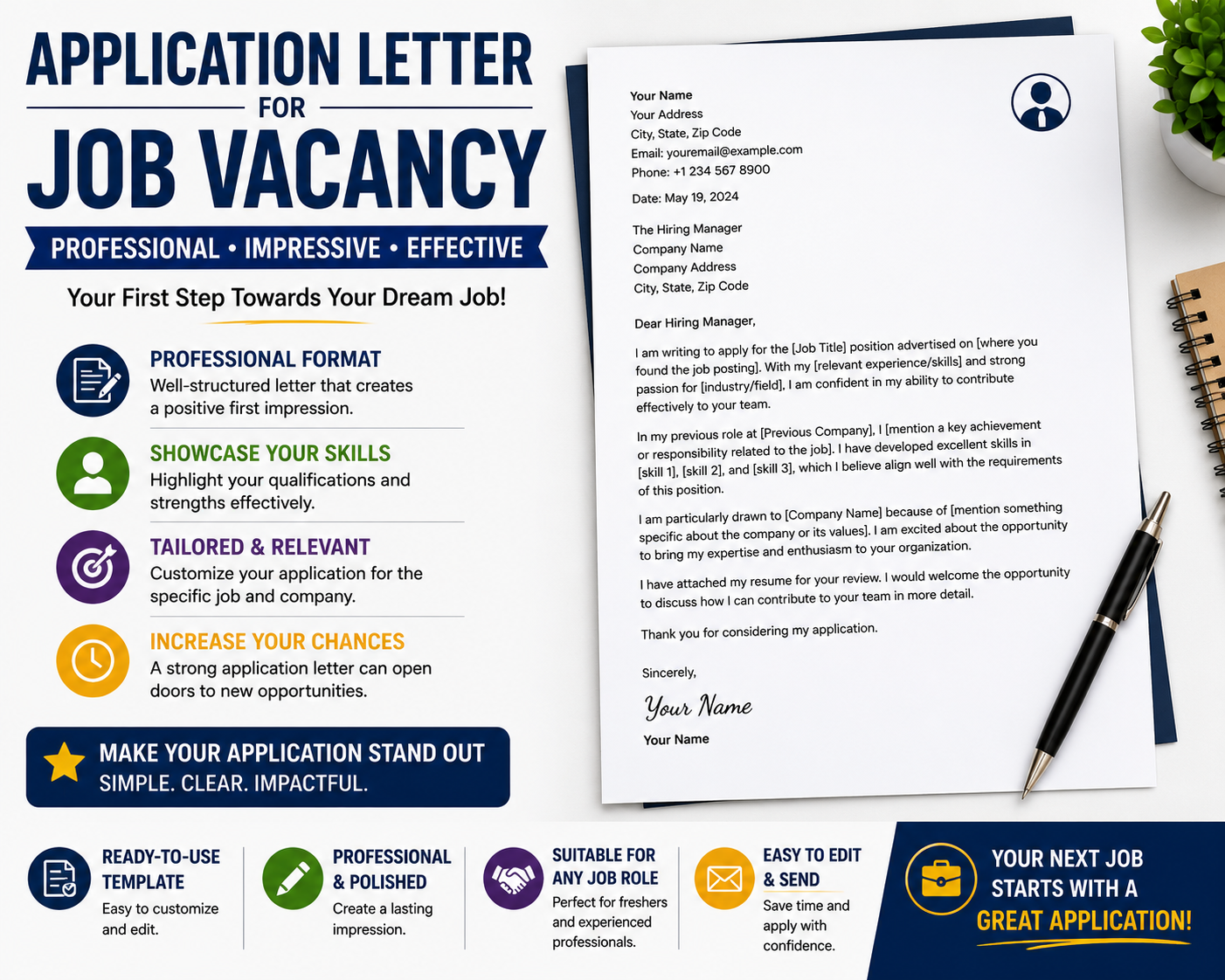
5 Professional Templates That Get You Shortlisted — 2026 Edition
5 Templates IncludedUpdated June 2026Freshers & ExperiencedFormal & Email Formats
In a competitive job market, your application letter for a job vacancy is often the very first impression a hiring manager has of you. Before they read your CV, before they see your LinkedIn profile, and before they even know your name properly — they read your letter. In those few paragraphs, they form an opinion about your communication skills, your professionalism, and how well you understand what the role requires. Getting this letter right is not just helpful — in many cases, it is the deciding factor between being shortlisted and being overlooked.
An application letter for a job vacancy is a formal written document submitted alongside — or sometimes instead of — a CV when applying for a position. It is your opportunity to introduce yourself, explain why you are interested in the specific role, and demonstrate that you possess the qualifications and qualities that make you the right candidate. Unlike a CV, which is a structured list of facts, an application letter allows you to present yourself in your own voice, make a compelling case, and connect your experience directly to the employer’s needs.
In 2026, despite the rise of online application systems, LinkedIn Easy Apply, and AI-assisted recruitment, the application letter remains a powerful differentiator. Candidates who submit a well-crafted, tailored letter consistently outperform those who do not — because it signals effort, interest, and communication competence. Automated applicant tracking systems (ATS) are increasingly sophisticated, but hiring managers still read letters personally for shortlisted candidates, and a generic or poorly written letter is a fast track to rejection.
This guide explains exactly how to write a job vacancy application letter that stands out — whether you are a fresh graduate, a seasoned professional, an internal candidate, or someone making a speculative enquiry. You will find five complete, ready-to-use templates, a detailed breakdown of the ideal structure, common mistakes to avoid, and clear answers to the most frequently asked questions.
Quick Answer: An application letter for a job vacancy should be 3–4 paragraphs long and include: who you are and what role you are applying for, your most relevant qualifications and achievements with measurable examples, why you specifically want to work at that company, and a clear call to action requesting an interview. Always tailor it to the specific role — never use a generic template without personalising it. See the five complete templates below.
1. What Is an Application Letter for a Job Vacancy?
An application letter for a job vacancy is a formal, standalone letter submitted to an employer when applying for a specific position. Its primary purpose is to express your interest in the role, summarise your most relevant qualifications and experience, and persuade the hiring manager to invite you for an interview. It is one of the most important documents in the job application process.
Unlike a CV or résumé — which is a structured, factual summary of your education, experience, and skills — an application letter is written in continuous prose and tells a story. It gives you the space to explain context, highlight the most relevant aspects of your background for this particular role, and express genuine enthusiasm for the company and position. Think of your CV as the data and your application letter as the narrative that brings that data to life.
When Is an Application Letter Used?
When applying for an advertised job vacancy (newspaper, job board, company website)
As a covering document submitted alongside your CV via email or an online portal
For speculative (cold) applications where no vacancy is currently advertised
For internal job applications within your current organisation
In certain industries or countries where a formal letter is the cultural and professional norm
When an employer specifically requests an “application letter” rather than just a CV
In some contexts — particularly in parts of South Asia, Africa, and for government or academic positions — an application letter is expected to be more detailed and formal than a typical Western cover letter, sometimes functioning as a standalone document without a separate CV attachment. Understanding this distinction is important when tailoring your approach.
2. Application Letter vs. Cover Letter — What’s the Difference?
The terms “application letter” and “cover letter” are frequently used interchangeably, but they have meaningful differences that can affect how you write each one. Understanding these differences helps you produce the right document for the right context.
Feature
Application Letter
Cover Letter
Primary Purpose
To formally apply for a position AND present qualifications in detail
To introduce your CV and briefly highlight why you are applying
Length
3–5 paragraphs; can be longer and more detailed
3–4 short paragraphs; typically briefer and more concise
Standalone?
Can function as a standalone document in some contexts
Always accompanies a CV; rarely standalone
Level of Detail
More detailed; includes specific achievements and reasoning
More concise; refers the reader to the attached CV for detail
Formality
Typically more formal; used in academic, government, and traditional industries
Can be slightly more conversational; common in startups and creative fields
Personalisation
Highly tailored to both the role and the specific company
Should be tailored but often shorter versions are used
Common Usage
Government jobs, academic positions, formal sector, South Asia, Africa
💡 In Practice: If an employer asks for an “application letter,” write a detailed, formal document. If they ask for a “cover letter,” keep it concise. When in doubt, err on the side of more detail and formality — it is always better to say more than too little.
3. Structure of a Winning Application Letter
A well-structured application letter follows a clear, logical format that guides the reader from introduction through to a confident call to action. Each section has a specific job to do. Here is what each part should contain and how long it should be:
Section
Content
Suggested Length
Your Contact Details
Full name, phone number, email address, LinkedIn (if applicable). Place at the top.
3–4 lines
Date
Full date of writing (e.g., 20 June 2026)
1 line
Recipient Details
Hiring manager’s name, title, company name, and address if known
3–4 lines
Subject / Reference Line
The specific role you are applying for, and reference number if given
1 line
Opening Salutation
Use the hiring manager’s name when known (Dear Ms. Chen). Use “Dear Hiring Manager” if not known.
1 line
First Paragraph
Who you are, what role you are applying for, where you saw it advertised, and a strong opening hook that communicates your most compelling selling point immediately.
3–5 sentences
Second Paragraph
Your most relevant qualifications and achievements. Be specific — use numbers, results, and named examples. This is the core of your letter.
4–6 sentences
Third Paragraph
Why THIS specific company — not a generic statement. Research them and mention something specific: a product, project, value, recent news, or aspect of their culture that genuinely appeals to you.
3–4 sentences
Closing Paragraph
A confident, clear call to action. Request an interview, state your availability, mention your CV is attached, and thank the reader for their time.
2–3 sentences
Sign-Off
“Yours sincerely” (when you know the name) or “Yours faithfully” (when you don’t). Include your full name below.
2 lines
4. What to Include and What to Leave Out
✅ Include
❌ Leave Out
The specific job title and where you found the vacancy
A generic opening such as “I am writing to apply for a job at your company”
1–2 specific achievements with measurable results (numbers, percentages, timeframes)
A rehash of every job on your CV — the letter should complement, not repeat, your CV
A genuine, specific reason for wanting to work at that company in particular
Generic flattery (“Your company is a leader in its industry”) without any substance
Your most relevant skills and qualifications, directly linked to the job description
Unrelated personal details (age, marital status, religion, unless relevant to the role)
A confident but professional tone throughout
Desperate or overly submissive language (“I humbly beg to apply…”)
A specific call to action (requesting an interview)
Salary expectations (unless the employer specifically asked for them)
Your contact details and availability for interview
Negative comments about current or past employers — never, under any circumstances
A note that your CV is attached or enclosed
Spelling errors, grammatical mistakes, or formatting inconsistencies
5. Step-by-Step: How to Write an Application Letter for a Job Vacancy
1
Research the company and the role thoroughly before writing a single word
Read the full job description carefully and note the key requirements. Then research the company — their website, recent news, mission statement, and LinkedIn page. This research will make your “why this company” paragraph authentic and specific rather than generic. The difference between a forgettable letter and one that gets an interview call is almost always this level of tailored effort.
2
Identify your two or three most relevant achievements for this specific role
Before writing, decide which accomplishments from your background most directly match what the employer is looking for. Convert them into specific, quantified examples where possible: not “I improved sales” but “I increased quarterly revenue by 23% through a targeted outreach strategy.” Select the most powerful two or three — you cannot include everything, and you should not try to.
3
Write a compelling opening that immediately establishes your value
Avoid starting with “I am writing to apply for…” — every other applicant does this. Instead, lead with your strongest point. For example: “With eight years of experience leading cross-functional marketing teams and a proven record of launching campaigns that consistently exceed targets, I am excited to bring this expertise to the Marketing Director role at [Company].” Hook the reader immediately.
4
Write your “why this company” paragraph with genuine, specific detail
This is the paragraph that most applicants get wrong. Do not write “I am drawn to your company because of its excellent reputation.” Instead, name something real: a product you use, a project they recently launched, a value they publicly champion, or a piece of their work that genuinely impressed you. Hiring managers can tell the difference between genuine interest and a copy-paste paragraph instantly — and it matters enormously to them.
5
Close with a confident, specific call to action
Do not end passively (“I hope to hear from you”). End with a direct but polite request: “I would welcome the opportunity to discuss my application at your convenience and am available for an interview at short notice.” Confirm that your CV is attached, thank the reader for their time, and use the appropriate sign-off. “Yours sincerely” when you know the recipient’s name; “Yours faithfully” when you do not.
6
Proofread rigorously — then proofread again
A single typo or grammatical error in an application letter can eliminate an otherwise excellent candidate. Read it aloud to catch awkward phrasing. Use spell-check, but do not rely on it alone (it will not catch “their” vs. “there”). Ask a trusted colleague or friend to review it before sending. Never submit a letter you have written in a rush without a thorough review — it signals carelessness, which is the last impression you want to leave.
6. Five Professional Application Letter Templates
Here are five complete, detailed, and realistic application letter templates for the most common job application scenarios. Each template is ready to use — simply replace the highlighted placeholders with your own information. Personalise the “why this company” section for every application you submit.
Template 1 — ProfessionalStandard Professional (Experienced Candidate)
[Your Full Name] | [Phone Number] | [Email Address] | [LinkedIn URL][Date, e.g., 20 June 2026][Hiring Manager’s Full Name][Their Job Title][Company Name][Company Address]
Re: Application for [Job Title] — [Reference Number if given]
Dear [Mr./Ms. Hiring Manager’s Surname],
I am writing to apply for the position of [Job Title] as advertised on [Source, e.g., LinkedIn / your company website / Indeed]. With [X years] of experience in [field/industry] and a proven track record of [key achievement, e.g., “delivering high-impact digital marketing campaigns that consistently exceed KPIs”], I am confident in my ability to make an immediate and meaningful contribution to [Company Name].
In my current role as [Job Title] at [Current Company], I [specific achievement with measurable outcome, e.g., “led a team of 8 that increased customer retention by 34% over 18 months through a redesigned onboarding programme”]. I also [second relevant achievement, e.g., “managed a £1.2 million annual budget with zero overspend across three consecutive fiscal years”]. These experiences have equipped me with [2–3 key skills, e.g., “deep expertise in CRM strategy, cross-functional stakeholder management, and data-driven decision-making”] — skills that directly align with the requirements outlined in your job description.
I am particularly drawn to [Company Name] because [specific, genuine reason — e.g., “of your commitment to building inclusive financial products for underserved communities. I have followed your work since the launch of [Product/Initiative] in 2024 and deeply admire the approach your team has taken”]. I believe my background in [relevant area] positions me well to contribute to [specific goal, project, or team] from day one.
I would welcome the opportunity to discuss my application in more detail at your convenience. I am available for an interview at any time and can be reached at [Phone Number] or [Email Address]. Please find my CV attached for your consideration.
Thank you for your time. I look forward to hearing from you.
Yours sincerely,
[Your Full Name]
[Your Full Name] | [Phone Number] | [Email Address][Date][Hiring Manager’s Name / “The Hiring Manager”][Company Name][Company Address]
Re: Application for [Job Title]
Dear [Mr./Ms. Surname / “Hiring Manager”],
I am writing to express my strong interest in the [Job Title] position at [Company Name]. I recently graduated from [University Name] with a [Degree, e.g., Bachelor of Science] in [Subject, e.g., Business Administration], achieving [grade/classification if strong, e.g., “a First Class result” / “a GPA of 3.8”], and I am eager to begin my professional career in [field] with an organisation whose work I genuinely admire.
During my studies, I developed strong [relevant skills, e.g., “analytical and project management skills”] through a combination of academic coursework and practical experience. My final year project on [topic, e.g., “consumer behaviour patterns in e-commerce”] gave me hands-on experience in [specific skill, e.g., “data collection, statistical analysis using SPSS, and presenting findings to a panel of industry practitioners”]. Additionally, during my internship at [Company Name], I [specific contribution, e.g., “supported the marketing team in a social media campaign that grew engagement by 41% over six weeks”]. While I am early in my career, I bring enthusiasm, a strong academic foundation, and a genuine commitment to professional growth and continuous learning.
I am drawn to [Company Name] specifically because [genuine reason, e.g., “of your reputation for investing in early-career talent through your graduate development programme, and because your focus on sustainable supply chain practices aligns with the research I conducted during my studies”]. I believe the [Job Title] role at [Company Name] is exactly where I want to build the foundation of my career.
I would be grateful for the opportunity to discuss my application further. My CV is attached for your review. Thank you for your time and consideration.
Best regards,
[Your Full Name][Phone Number]
[Your Full Name] | [Current Department] | Employee ID: [Employee ID][Date]
To: [HR Manager’s Name / Recruitment Committee][Department / HR Division][Company Name]
Subject: Internal Application — [Job Title] — [Department Name]
Dear [Recipient’s Name],
I am writing to formally apply for the [Job Title] position within the [Department Name] team, as advertised internally on [Date / internal portal / noticeboard].
Having worked at [Company Name] for [X years] in my current role as [Current Job Title], I have developed a comprehensive and first-hand understanding of the organisation’s processes, values, strategic priorities, and operational culture. In my current position, I [specific achievement directly relevant to the new role, e.g., “led the rollout of a new client reporting system that reduced processing time by 30% and improved client satisfaction scores across three business units”]. I believe this experience — combined with my familiarity with the organisation’s systems, teams, and expectations — directly positions me to contribute effectively to the [New Role] from the very start, without the onboarding curve that an external candidate would require.
I have discussed my interest in this career transition with [Current Manager’s Name], who is fully supportive of my application and is prepared to facilitate a thorough and professional handover of my current responsibilities to ensure no disruption to the team. I am committed to making this transition as smooth as possible for all parties.
I would welcome the opportunity to discuss my suitability for this role in more detail and am available for an internal interview at any time. My updated CV is attached for your review.
Thank you for your time and consideration. I look forward to the possibility of contributing to [Department Name] in this new capacity.
Yours sincerely,
[Your Full Name][Current Job Title] | Employee ID: [Employee ID]
Phone: [Phone Number]
Template 4 — SpeculativeSpeculative / Cold Application (No Advertised Vacancy)
[Your Full Name] | [Phone Number] | [Email Address][Date][Name / “The Hiring Manager”][Company Name][Address]
Dear [Name / “The Hiring Manager”],
I am writing to enquire about potential opportunities within [Company Name] in the area of [Job Type or Department, e.g., “software engineering” / “the commercial finance team”]. Although I have not seen a current vacancy advertised, I am very keen to be considered for any suitable positions that may arise now or in the future.
I am a [Job Title] with [X years] of experience in [field], specialising in [specific area of expertise]. In my most recent role at [Company Name], I [specific, standout achievement with measurable result, e.g., “architected a data pipeline that reduced reporting latency from 4 hours to under 12 minutes, directly improving decision-making speed for the executive team”]. I have also [second achievement or qualification, e.g., “led a cross-functional team of 12 through a complete ERP migration, delivered on time and within a £450,000 budget”]. My background includes [2–3 core competencies relevant to the company’s work].
I have followed [Company Name]‘s work for [time period, e.g., “the past two years”] and am genuinely impressed by [specific, authentic reason, e.g., “your approach to building developer tooling that genuinely reduces complexity — something I experienced first-hand when my current team adopted your API suite last year”]. I believe my background in [area] could be a strong and immediate fit for your team.
I have attached my CV for your consideration. I would be happy to have an informal conversation about any potential opportunities at your convenience, and I will follow up in [timeframe, e.g., “two weeks”] if I have not heard from you. Thank you very much for your time.
Best regards,
[Your Full Name][Phone Number]
[Your Full Name] | [Phone Number] | [Email Address][Date][Hiring Manager’s Name / “The Hiring Manager”][Company Name][Address]
Re: Application for [Job Title] — Ref: [Reference Number, if provided]
Dear [Mr./Ms. Surname / “Hiring Manager”],
I am writing in response to your advertisement for a [Job Title], posted in [Source, e.g., the Daily Tribune / on Indeed / on your company’s careers page] on [Date of advertisement]. Having reviewed the role requirements in detail, I believe my experience and skills make me a strong candidate, and I am excited by the opportunity to join [Company Name].
I currently work as a [Current Job Title] at [Current Company], where I have spent [X years] developing expertise in [relevant area]. A key achievement in my current role has been [specific accomplishment with measurable impact, e.g., “redesigning the customer complaints process, which reduced average resolution time by 47% and improved our Net Promoter Score from 31 to 58 over 12 months”]. I hold [relevant qualification or certification] and have extensive experience with [tools, systems, or methodologies directly referenced in the job description].
I am particularly drawn to [Company Name] because [specific and genuine reason — reference something real about the company, e.g., “of your reputation for pioneering patient-centred care and your recent recognition as one of the top 50 most innovative healthcare organisations in the country. This aligns directly with my professional values and the type of environment in which I know I do my best work”].
I would very much welcome the opportunity to discuss my application at interview. Please find my CV attached for your consideration. I am available at short notice and can be reached at [Phone Number] or [Email Address].
Thank you for your time. I look forward to hearing from you.
Yours sincerely,
[Your Full Name][Phone Number]
7. Mistakes That Get Applications Rejected
Recruitment professionals consistently report the same recurring errors in application letters. Avoiding these will immediately put your application above the majority of candidates who make them.
❌
Using a generic, untailored template: Submitting the same letter to every employer — without changing the company name, the role, or any specific details — is immediately apparent to experienced hiring managers. It signals low interest and low effort. Every letter you send must be personalised, at minimum in the “why this company” paragraph and the skills you choose to highlight.
❌
Starting with “I am writing to apply for…”: This opening is used by almost every applicant and immediately makes your letter blend in rather than stand out. Lead with your strongest credential, a compelling achievement, or a concise statement of your professional identity that relates directly to the role.
❌
Repeating your CV word for word: Your application letter should complement your CV, not duplicate it. The letter is where you connect the dots, provide context, and tell a story. If a hiring manager reads your letter and finds nothing they couldn’t have read directly on your CV, the letter has not done its job.
❌
Vague or unmeasurable claims: Statements like “I have excellent communication skills” or “I am a team player” are meaningless without evidence. Replace them with specific examples: “I presented quarterly strategy reviews to a board of 15 directors” or “I collaborated across three departments to deliver a £2M infrastructure project on schedule.”
❌
Getting the company name wrong: This happens more often than you might think — especially when candidates send multiple applications in a short period. Getting the company name wrong (or leaving in a previous company’s name from a template) is an instant rejection in virtually every organisation.
❌
Making the letter too long: A strong application letter is typically one page (300–450 words). Beyond this, you risk losing the reader’s attention. If you find yourself writing more than five paragraphs, you are probably including material that belongs in the interview, not the letter.
❌
Typos and grammatical errors: In roles where written communication matters — and most roles do — spelling and grammar errors in your application letter signal exactly the kind of carelessness you do not want to demonstrate. Proofread obsessively, and have at least one other person review your letter before you submit it.
❌
A passive or uncertain closing: Ending with “I hope to hear from you” or “please consider my application” sounds uncertain and passive. Close with a confident, direct request for an interview and a reminder of how to reach you.
⚠ ATS Warning (2026): Many large employers now use Applicant Tracking Systems to screen letters and CVs before a human reads them. Include key phrases from the job description in your application letter naturally — but never “keyword stuff” in a way that sounds unnatural. Write for the human first; the ATS second.
8. Frequently Asked Questions
An application letter should typically be one page in length, containing three to five paragraphs and approximately 300 to 450 words. This is long enough to present your qualifications compellingly and demonstrate genuine interest, but concise enough to respect the hiring manager’s time. Anything beyond one page risks losing the reader’s attention. If you are struggling to keep it to one page, review each sentence and ask whether it is earning its place.
Yes, in most cases. Including an application letter (or cover letter) even when it is not explicitly required demonstrates professionalism and initiative. It gives the hiring manager more context about who you are beyond the CV and shows that you have taken the time to think carefully about the application. The only exception is when the job posting explicitly states “no cover letters” — in which case, follow the instruction.
This is a formal letter convention used primarily in British English. Use “Yours sincerely” when you know the name of the person you are writing to (e.g., “Dear Ms. Robinson”). Use “Yours faithfully” when you do not know the name and have addressed the letter to “Dear Sir/Madam” or “Dear Hiring Manager.” In American English, both are less commonly used and “Best regards” or “Sincerely” are perfectly appropriate in all contexts.
You can use the same letter as a structural template, but you must tailor the content for each application — and this is non-negotiable. At minimum, you should change the company name, the specific role you are applying for, and the “why this company” paragraph for every application. Ideally, you should also adjust the qualifications and achievements you highlight to best match each individual job description. Submitting an untailored, generic letter is one of the most common and most damaging mistakes job seekers make.
No — do not include your current salary in your application letter unless the job advertisement specifically asks you to state salary expectations. Disclosing salary information too early in the process can put you at a negotiating disadvantage. If the employer explicitly requests salary expectations in the application, provide a realistic range based on your research of the role and market rate rather than a single fixed figure.
The DMessages editorial team specialises in professional communication templates, career writing guides, and workplace business English resources. All templates are reviewed for professional accuracy, industry relevance, and real-world usability before publication. Our job application guides are read by hundreds of thousands of job seekers annually.
Ready to Write Your Application Letter?
Use any of the five templates above as your starting point — then personalise every section for the specific role and company you are targeting. A tailored, well-written application letter is one of the most powerful tools in your job search. Explore more professional writing templates at dmessages.com.